



After a month-long hiatus from publishing, technology commentator and RouteMesh executive Kerman Kohli has returned with a sweeping assessment of the artificial intelligence sector, offering a deeply empirical look at the shifting economics of hardware, model evolution, and the ongoing tug-of-war between local setups and frontier AI labs. Drawing from personal investments in high-end inference machines and cluster infrastructure, the commentary challenges prevailing market skepticism, arguing that traditional economic assumptions about hardware depreciation, token pricing, and market bubbles are fundamentally misreading the current trajectory of the industry.
Kohli’s insights stem directly from personal financial and operational exposure to the AI hardware market over the past year. Earlier this year, Kohli built a $15,000 local inference machine, a setup that was recently
expanded with an additional graphics processing unit to reach a nominal valuation of $35,000. However, due to severe market constraints and price appreciation, the components tell a paradoxical story. A GPU that previously cost $10,000 now commands $14,000, while specialized system RAM appreciated by an additional $1,000. This effectively pushed the cost basis of the upgraded rig down to $30,000, bucking standard technological depreciation curves where hardware loses value almost immediately upon purchase.
This capital expenditure did not stop at single-machine upgrades. Kohli further expanded operations by investing $35,000 into six DGX Spark nodes interconnected via a 16x100Gb switch requiring fiber optic cabling. According to Kohli, acquiring and configuring physical metal yields insights unattainable through online research alone. These expansions are slated to continue at RouteMesh, where GPU clusters represent the next logical scaling phase. The central mystery underlying these investments—how a machine less than a year old appreciates, or how a used 2020 RTX 3090 retains its market value in 2026—cannot be dismissed as a temporary bubble. Understanding this phenomenon requires examining the fundamental bottleneck of modern computing: memory.
When analyzing AI hardware, observers frequently conflate compute capacity with memory constraints. While processing compute delivered by central processing units, graphics processing units, and specialized accelerators naturally advances with newer generations, raw compute is rarely the primary performance bottleneck during inference. Instead, memory remains the limiting factor. Given that the industry faces a structural shortage of high-performance memory projected to last for at least another decade—an upward revision from prior five-year estimates—any potential depreciation in older compute generations is fully offset by the scarcity and high value of memory.
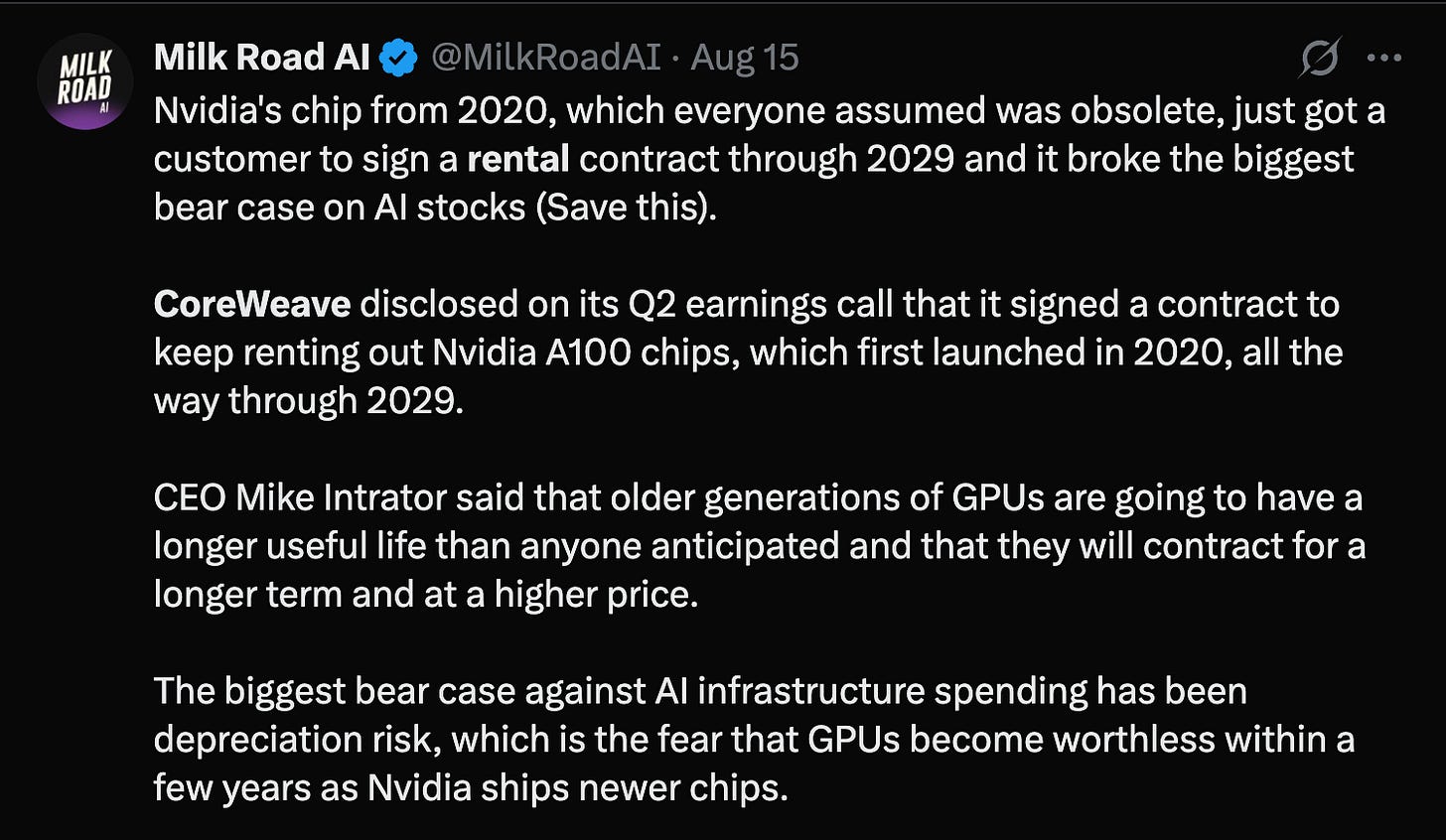
Compounding this dynamic is NVIDIA’s robust backwards compatibility and extensive software ecosystem. Older silicon architectures, such as the RTX 3090 or enterprise-grade A100 chips from 2020, remain entirely viable for running economically valuable inference workloads. This has tethered specific workloads to older hardware generations in a manner unseen in the technology sector for decades. Kohli notes personal experience with an RTX 6000 Pro Max-Q purchased for $10,000, which has since appreciated in market value to between $16,000 and $18,000—a structural trend rather than a transient market imbalance.
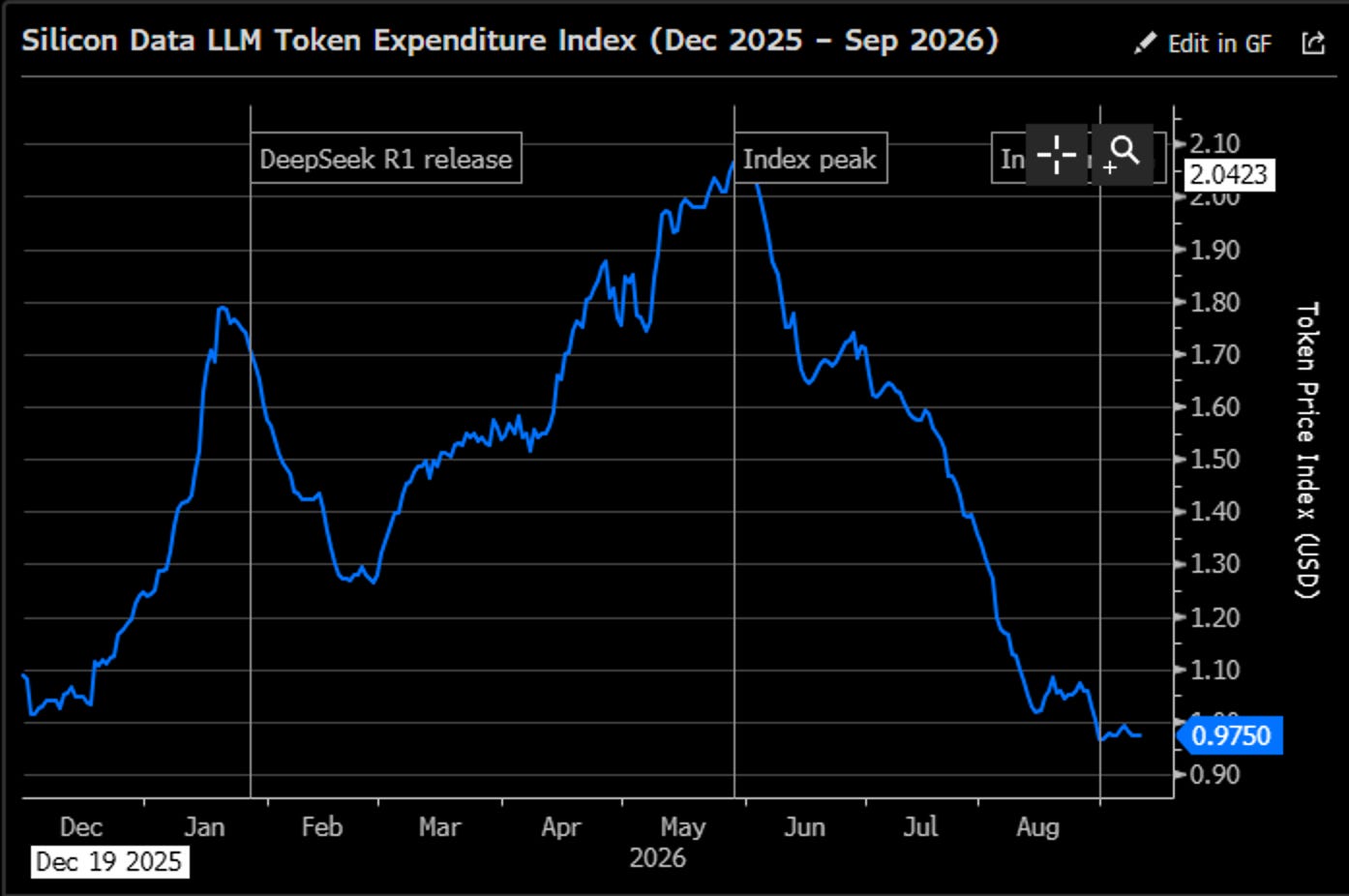
Critics of the current AI boom frequently point to falling token prices as evidence of an impending market correction or bubble collapse. Under traditional economic frameworks, cheaper tokens should signal declining demand or oversupplied markets. However, this perspective overlooks the explosive growth on the demand side of the equation. Data from Silicon Data indicates that token prices have drifted downward since June, leading some market analysts to conclude that artificial intelligence demand is cooling.
Yet, when examining NVIDIA’s data center revenue as a proxy for infrastructure demand, an entirely different narrative emerges. Growth figures continue to surge upward and to the right, fundamentally constrained not by demand, but by supply. Kohli argues that the demand for intelligence is effectively infinite and that use cases remain entirely unbounded. While standard economic theory dictates that supply eventually scales to meet demand, the insatiable appetite for automated intelligence means that physical supply will struggle to catch up. Failing to recognize this dynamic leaves organizations and investors vulnerable to severe market miscalculations.
Consequently, owning localized compute is emerging as a critical strategic asset rather than a mere operational expense. Entities that lack dedicated compute infrastructure risk losing control over their proprietary ideas and intellectual property—a risk underscored by recent high-profile mathematical achievements, such as the resolution of the Navier-Stokes fluid dynamics problem and its associated prizes.
Simultaneously, falling token prices are unlocking recursive patterns of utility. Lower costs allow developers and power users to bake deeper layers of intelligence into everyday software ecosystems. Kohli describes a personal workflow where localized software orchestrates increasingly complex agentic tasks, creating a self-reinforcing loop of demand where intelligence generation requires even more intelligence to manage. This recursive agentic demand further reinforces the thesis that the market is nowhere near a point of saturation.
The past month has also witnessed step-change breakthroughs in local intelligence capabilities. Releases such as Qwen 3.8 DFlash2 and GLM 5.3 Flash Next DFlash2 have dramatically accelerated the speed and sophistication of tasks that can be orchestrated on localized hardware. Kohli reports that a dual-GPU workstation and a multi-node spark setup now provide near-complete compute self-sufficiency, with frontier subscriptions reserved strictly for specialized computer-use tasks, iOS integrations, and exceptionally complex computational problems.
Despite the rapid empowerment of local hardware setups, the existence of local alternatives does not spell the end for centralized frontier labs. OpenAI, Anthropic, and other major players command massive reserves of proprietary compute and maintain a distinct brand advantage within enterprise markets, particularly within the United States. For most enterprises, the calculation of investing tens of thousands of dollars in capital expenditure versus paying recurring cloud subscription fees will favor managed services—at least until hardware scarcity and rising procurement costs make local ownership an absolute imperative.
Ultimately, navigating the next decade of technological development requires internalizing two foundational premises: that compute is transitioning into the world’s most vital strategic resource, and that the global demand for intelligence is effectively infinite. Operating under the assumption of infinite demand shatters conventional economic models, altering how organizations view competition and collective human organization. For participants across technology, investment, and enterprise strategy, failing to secure a long position in compute—whether through career specialization, portfolio allocation, or physical hardware acquisition—carries profound long-term risks.



Comments (0)