



Financial markets closed with a pronounced risk-off tone across traditional tech equities, the broader cryptocurrency ecosystem, and digital asset mining operations. Amid a widespread retreat from high-beta assets, investors sought safety in traditional havens like gold, while technology and crypto indices absorbed heavy selling pressure. Meanwhile, the structural evolution of alternative financial products continued at a rapid pace, highlighted by retail brokerage giant Robinhood unveiling a major roadmap expansion for its high-flying prediction market offerings. The convergence of macro headwinds in legacy tech and explosive growth in retail-driven event contracts paints a complex picture of shifting investor behavior as market participants position themselves for the year ahead.
Broad Indices and Market Indices Face Macro Pressures
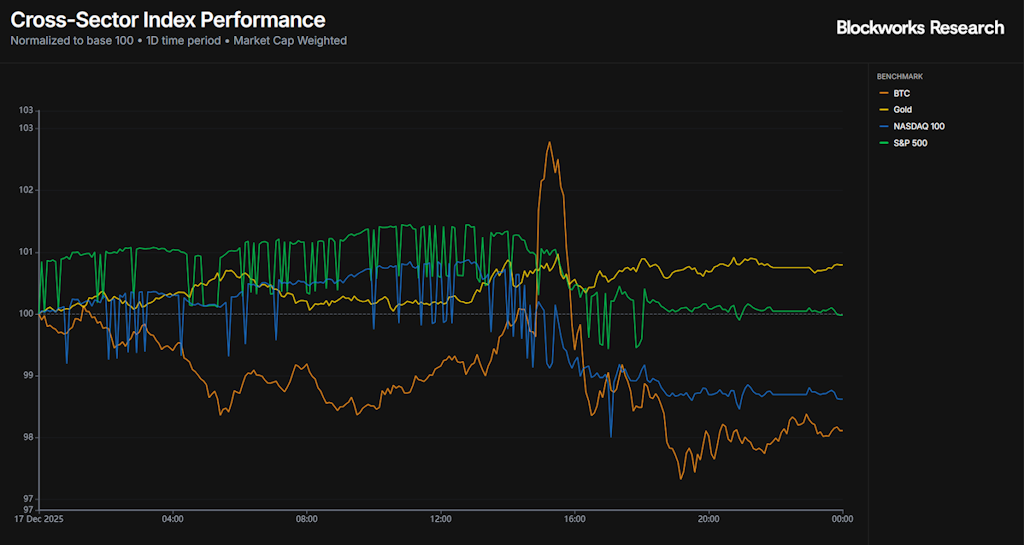
Global markets experienced a definitive risk-off session, with risk assets sliding across the board as macroeconomic anxieties and sector-specific headwinds weighed heavily on sentiment. Precious metals stood out as the lone major bright spot, with gold advancing 0.8% by the closing bell. In contrast, equities struggled to find a solid footing. The S&P 500 finished the session essentially flat, while the technology-heavy Nasdaq Composite dropped 1.38%. The weakness in traditional tech quickly bled over into digital assets, dragging flagship cryptocurrency Bitcoin down by 1.89%.
The underlying macroeconomic and sector-specific drivers behind the equity slump remained largely consistent with recent trends, anchored by a steady and aggressive rotation away from the red-hot artificial intelligence trade. Investor sentiment across the technology sector was rattled once again by unsettling reports regarding a high-profile data center project. According to the headlines, a key investor had reportedly pulled out of a major infrastructure initiative tied to Oracle. Although Oracle moved quickly to publicly dispute the claims and clarify the situation, the initial news flash was more than enough to unnerve an already cautious marketplace. Investors, operating in an environment characterized by elevated valuations and tightening liquidity conditions, used the headline as a catalyst to shift further into defensive positioning, exacerbating the sell-off in growth-oriented equities.

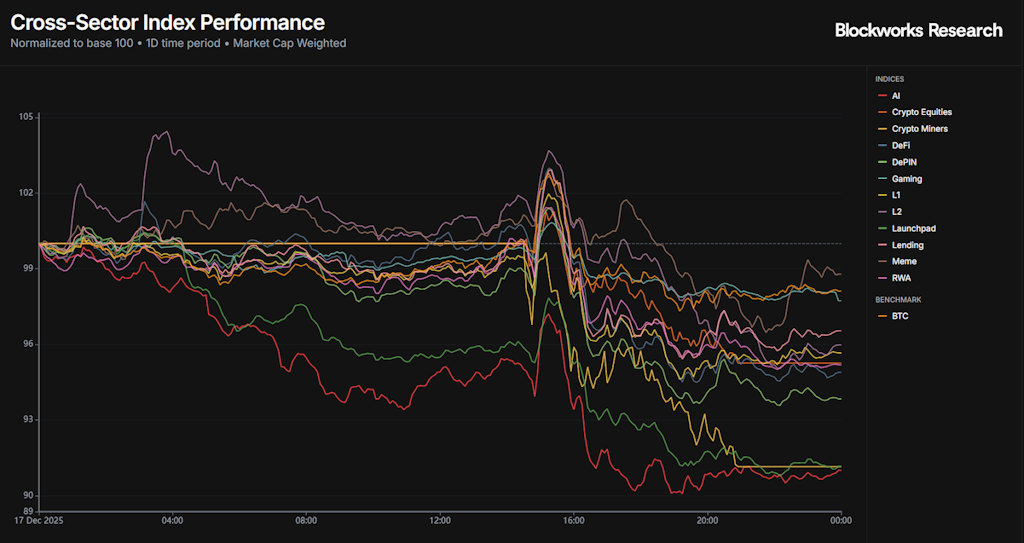
This broader equity weakness rapidly spilled over into the digital asset landscape, causing every major crypto sector index to finish the trading day firmly in the red. However, the session was not entirely devoid of localized resilience. In a surprising display of relative strength, the broader meme coin index declined by a relatively modest 1.2%. This muted downside is particularly notable given that sentiment-sensitive meme tokens typically suffer outsized losses during broader market downturns. The index managed to find crucial support from MemeCore, which stood out as the single constituent within the sector to close in positive territory, logging a modest gain of 1.96% for the day.
Conversely, the hardest-hit sectors within the digital asset ecosystem were crypto miners and artificial intelligence tokens, both of which suffered steep declines approaching 9% on average. Digital asset mining companies continue to face intense downward pressure, driven largely by cascading fears that the broader artificial intelligence narrative is rolling over and taking high-performance computing valuations down with it. For instance, prominent miner IREN has seen its market valuation plummet by roughly 31% over the past month alone. Within the AI-focused token index, Bittensor proved to be the weakest performer, tumbling 9% despite having recently undergone its scheduled token halving event—a milestone that typically generates bullish supply-side dynamics.
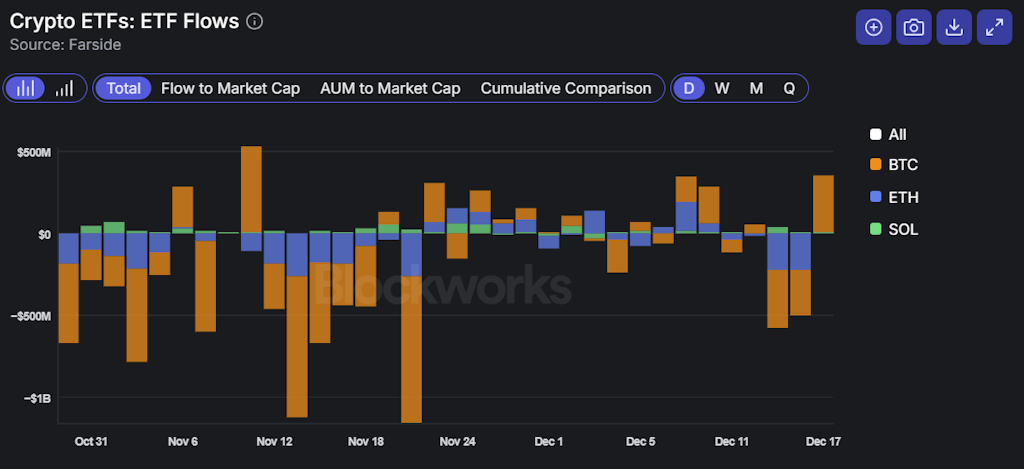
Despite the prevailing negative market sentiment and the heavy selling pressure across multiple asset classes, institutional crypto products offered a glimmer of hope for market bulls. Bitcoin exchange-traded funds reversed their recent outflow trend, flipping positive once again and notching an impressive $346.1 million in net inflows during the single trading session. Market participants and analysts alike are closely monitoring these flows, hoping that this sudden resurgence of institutional demand can maintain momentum for a few consecutive days to help the broader cryptocurrency market close out the year on a more stable and constructive footing.
Robinhood Leads the Charge in Prediction Market Expansion
While traditional equities and risk assets wrestled with macro uncertainty, the alternative financial product landscape witnessed another major structural milestone. Prediction markets have rapidly emerged as one of the most dynamic and closely watched segments of the modern financial services industry, capturing the attention of both retail traders and institutional market makers. This surging structural growth was underscored this week by retail brokerage pioneer Robinhood, which used its marquee keynote event to unveil a sweeping roadmap of new features designed to supercharge its prediction market offerings.
The strategic pivot toward prediction markets makes undeniable business sense for the retail brokerage platform. Over recent months, prediction markets have rapidly evolved into Robinhood’s fastest-growing product category by revenue generation. The scale of adoption has been staggering, with platform data indicating that users have already traded an astonishing 11 billion contracts, driven by active participation from more than 1 million unique users. This rapid scaling demonstrates a massive, previously untapped appetite among everyday retail investors for event-driven contracts that go beyond traditional equity and options trading.
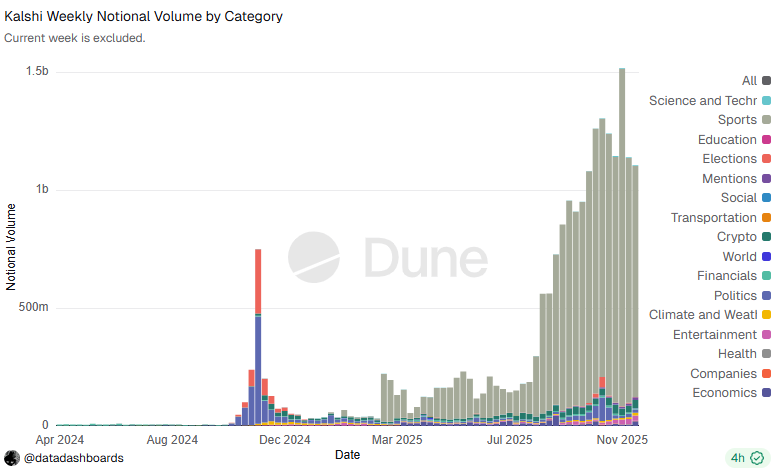
A closer look at the underlying volume metrics reveals that sports-related contracts continue to serve as the undeniable primary driver of this explosive activity. Sports prediction markets currently account for approximately 35% of total trading volumes on decentralized pioneer Polymarket and represent an overwhelming 90% of volume on regulated exchange Kalshi. To contextualize the sheer economic scale of this phenomenon, annualizing the sports betting volumes recorded across both platforms over the past four weeks yields an estimated combined volume of roughly $74.5 billion. For comparison, traditional heavyweight sportsbook FanDuel reported approximately $50.7 billion in total wagers handled throughout the entirety of 2024, while rival DraftKings recorded roughly $49.4 billion. These staggering comparisons underscore a fundamental reality of the modern financial landscape: prediction markets are no longer a niche, experimental product category. Instead, they have matured into mainstream financial instruments that are directly competing with, and in some cases outpacing, established Web2 gaming and betting incumbents.
Despite this massive volume and clear product-market fit, the prediction market ecosystem has historically lacked one vital feature that has long driven the profitability and popularity of traditional sportsbooks: parlays. In the conventional sports betting industry, parlays account for roughly 30% of total betting handle across key US jurisdictions like Maryland, Illinois, and New Jersey, while generating nearly 60% of total industry revenues for operators. Parlays function by bundling multiple distinct wagers into a single, cohesive bet. While this structure offers significantly higher potential payouts to the bettor, it simultaneously carries a far lower statistical probability of winning. This mathematical reality is precisely what makes parlay products exceptionally lucrative for the operating platforms.
Recognizing this massive revenue and engagement opportunity, Robinhood is now moving aggressively into this territory. During its keynote presentation, the company announced that retail users will soon gain the capability to trade complex combinations of outcomes, point
totals, and point spreads for individual National Football League games. Looking further ahead on its product roadmap toward early 2026, Robinhood plans to roll out functionality that will enable users to construct custom, multi-legged combinations involving up to 10 distinct outcomes for individual NFL matchups. In addition to team-level combinations, the brokerage will roll out trading capabilities centered on individual player performance metrics, introducing player prop betting to its prediction market suite.
This upcoming rollout represents a profound quantitative and qualitative leap beyond the basic, binary win-or-lose markets that currently dominate the prediction market landscape. By introducing sophisticated multi-leg combinations and player props, Robinhood is deliberately opening the door to significantly higher levels of speculation, trading frequency, and overall market volume. Furthermore, the company has already signaled its intention to extend these advanced multi-leg features beyond football and eventually expand the product framework beyond sports entirely into macroeconomic, political, and cultural event contracts.
An open question remaining across the industry is how Robinhood will choose to architect its expanding product suite over the long term. Specifically, market observers are watching to see whether these sophisticated parlay and prop products will continue to be developed in strategic partnership with regulated exchanges like Kalshi or if the brokerage intends to bring the underlying infrastructure fully in-house. This strategic question took on added relevance following Robinhood’s recent announcement regarding its plans to build out proprietary prediction market infrastructure through a newly formed joint venture with Susquehanna International Group.
The competitive landscape is heating up rapidly, with legacy crypto and fintech players positioning themselves for dominance in the sector. Notably, Coinbase also made strategic waves in the prediction market arena by announcing a high-profile partnership with Kalshi to roll out integrated prediction market trading capabilities directly to its own user base. As traditional brokerages, crypto exchanges, and regulated event-contract platforms race to capture market share, a corporate arms race is clearly underway.
Sports prediction markets have definitively proven their product-market fit throughout the year. Armed with massive retail distribution at scale and increasingly sophisticated, multi-legged product offerings, Robinhood’s aggressive strategic maneuvers could provide the firm with a formidable competitive edge in the battle for retail volume. As the industry looks toward the horizon, the intersection of traditional brokerage infrastructure, decentralized prediction protocols, and regulated event contracts is reshaping the boundaries of modern retail speculation.





Comments (0)