


RouteMesh has reached a significant operational milestone, tracking thousands of active blockchain nodes within its ecosystem to

provide unprecedented visibility into the software client landscape across decentralized networks. Traditionally, comprehensive data tracking which specific client software powers various blockchain networks has been sparse and fragmented. By continuously benchmarking and extracting metadata from newly integrated nodes, RouteMesh has mapped out how client diversity functions at scale across more than 30 integrated Remote Procedure Call (RPC) providers, offering a broad proxy for the wider blockchain infrastructure industry.

To run a functional blockchain network, operators rely on distinct software implementations commonly referred to as "clients." The most prominent example in the industry is "geth," short for go-ethereum, which serves as the leading software client for the Ethereum network. Over the years, however, the ecosystem has expanded significantly. When a blockchain introduces modifications to its underlying consensus, operational rules, or execution mechanisms, developers either adapt the foundational geth codebase or engineer entirely new client software from scratch. Furthermore, major blockchain networks often benefit from the introduction of competing client software developed by independent teams. This multi-client approach enhances overall network resilience, a critical architectural property known as "client diversity."

Because RouteMesh manages thousands of active nodes, it is uniquely positioned to quantify client diversity across the broader blockchain ecosystem in a way that has rarely been achieved previously. The platform’s internal architecture periodically re-discovers the state of these nodes every few days to monitor real-time developments, such as software version updates and infrastructure configuration changes implemented by various node providers. While RouteMesh’s coverage is extensive, encompassing more than 30 RPC providers, the dataset serves as an approximate proxy for the global ecosystem rather than an exhaustive census, as capturing every single node globally remains an ongoing challenge. Publicly accessible tracking for this client data is maintained online via the RouteMesh platform.

An analysis of the integrated RPC providers reveals that a substantial majority of nodes operate using geth as their execution client. Although researchers initially anticipated a more evenly distributed market share among alternative software options, geth remains the dominant force across the cross-chain landscape. Following geth in terms of absolute node counts is reth, a high-performance execution client developed by Paradigm. While the current data evaluates absolute node counts rather than the exact volume of requests served by each client type, the two metrics are closely correlated within enterprise and developer infrastructure.

When examining the underlying data sorted by individual blockchain networks rather than global market share, distinct patterns emerge regarding cross-chain adoption. Geth maintains its status as the most cross-chain dominant software, serving as the backbone for hundreds of distinct networks across the decentralized ecosystem. Following geth are several alternative clients that maintain varying degrees of multi-chain presence, including cdk-erigon, Nethermind, skaled, zkSync, erigon, go-opera, OpenEthereum, and bor, each catering to specific network architectures and scaling solutions.

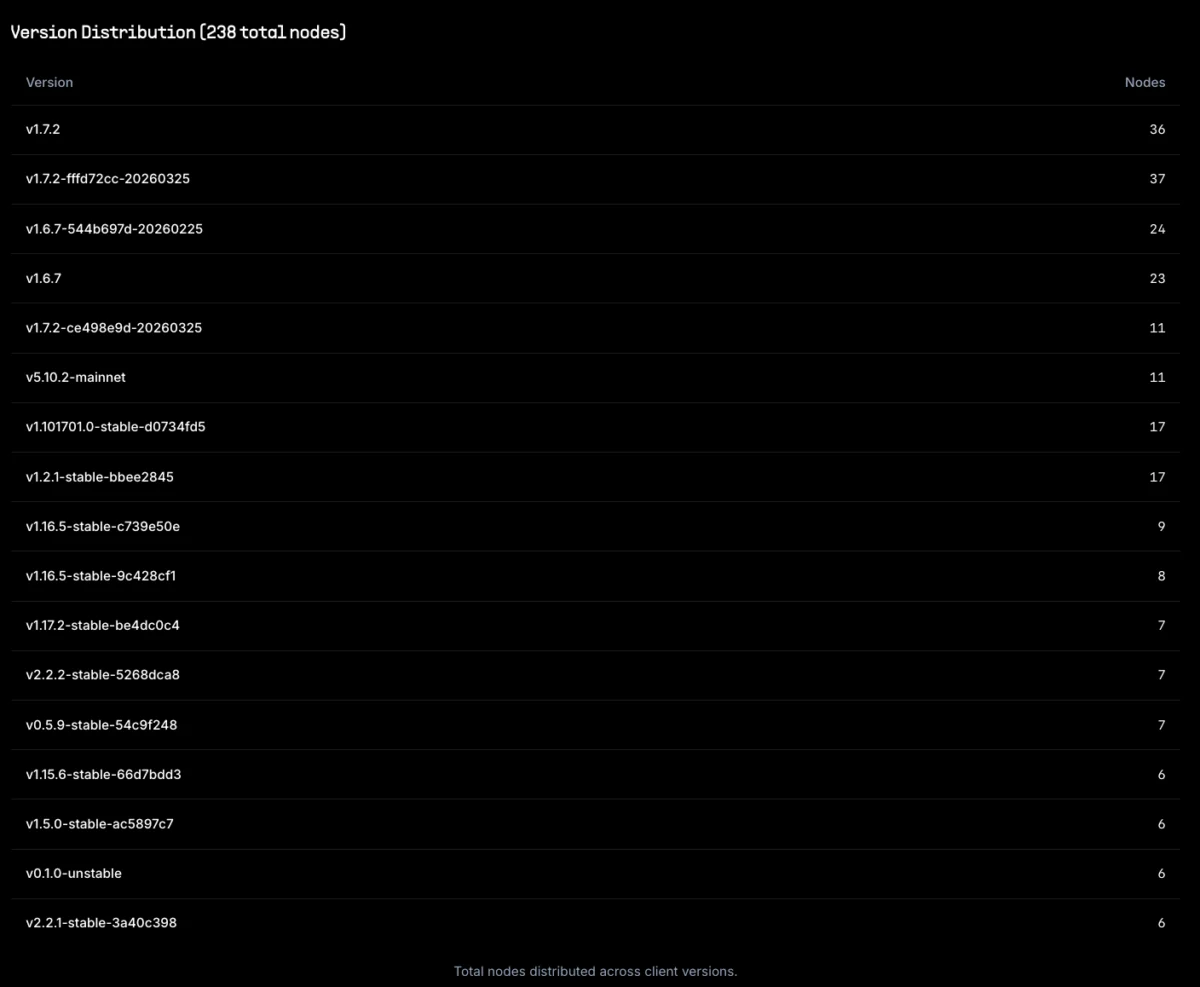
A closer inspection of individual client stacks highlights the sheer breadth of geth’s footprint, powering hundreds of separate chain stacks across the cryptosphere. However, evaluating the version distribution of these clients reveals significant variance in how quickly infrastructure providers adopt updates. Geth versions are widely dispersed across numerous releases, with older iterations still maintaining notable market presence. For instance, widely distributed version records show legacy iterations remaining active alongside newer deployments, such as updates initially rolled out in early 2026. The persistence of older software versions highlights potential operational vulnerabilities; if an infrastructure provider relies on a single node running an outdated client version, that node remains susceptible to discontinuation or network disruptions. RouteMesh’s multi-provider routing model mitigates this risk by incorporating robust fallback mechanisms.

The rollout of newer client versions introduces notable performance improvements, particularly for applications and protocols that rely on intensive RPC querying capabilities. However, the data demonstrates that infrastructure providers often exhibit a measured delay before upgrading their underlying node infrastructure to the latest software releases. This cadence reflects the operational caution inherent in managing production-grade blockchain nodes, where stability often takes precedence over immediate version adoption.

Evaluating alternative clients like reth reveals a different dynamic within the provider community. Built by the team at Paradigm, reth has established a strong foothold, particularly within specific ecosystems. The primary network supported by reth in the dataset is Base, followed by Ethereum, Optimism, Base Sepolia, Ethereum Sepolia, and Binance Smart Chain. Unlike the wide version spread observed in legacy geth deployments, reth implementations display a higher degree of version alignment among node runners. Providers managing reth infrastructure tend to remain more up to date with recent software releases, providing a greater level of operational consistency.

Among other notable software implementations, Nitro holds a dominant position within the Arbitrum scaling ecosystem, powering numerous mainstream and application-specific networks. Operators running Nitro-based infrastructure appear similarly proactive regarding version updates, with deployment concentrations clustering around recently stabilized releases while development teams continue iterating on subsequent release candidates. This coordination underscores a close operational relationship between core protocol developers and infrastructure providers within specific layer-two ecosystems.

The ongoing pipeline through which core developers release software updates, and the deliberate pace at which RPC providers adopt these changes, illustrates the complex mechanics behind decentralized infrastructure. RPC providers form the foundational layer of the blockchain economy, and tracking their operational habits grants the broader ecosystem vital transparency into how network requests are routed, processed, and secured. By bringing visibility to the lower-level software layer that powers modern blockchains, initiatives like RouteMesh’s client tracking aim to foster greater accountability and insight across the entire industry.



Comments (0)