


As the commercial landscape of large language models shifts and matures, heavy users are beginning to confront a stark economic reality: the era of seemingly unlimited, cheap AI compute is drawing to a close. For individuals who consume massive amounts of tokens daily—running through 100 million to 200 million tokens in a single day—relying on subscription-based API tiers and cloud platforms is becoming increasingly unsustainable. Companies offering fixed-rate plans are beginning to introduce stringent session limits, watering down model performance, and scaling back experimental features as the immense overhead of running massive artificial intelligence systems catches up with them.
This looming crunch has prompted a broader conversation among power users about the necessity of digital sovereignty and hardware ownership. For one prominent developer and high-volume LLM consumer, the response to tightening cloud limits and rising costs was to take matters into their own hands, embarking on a high-stakes hardware journey that culminated in the assembly of a custom, $15,000 local inference machine.
The motivation behind building a dedicated local rig goes beyond mere subscription fatigue. Industry observers and heavy power users have grown increasingly wary of relying entirely on centralized labs. Concerns range from the continuous tightening of compute availability to fears that proprietary platforms might leverage user data and ideas to train future iterations, driven by the immense profit margins required by major AI laboratories. Constructing a powerful, independent server setup offers a compelling alternative: running localized models continuously at the mere cost of electricity.
However, moving from cloud APIs to local hardware requires navigating a complex and often counterintuitive landscape of specialized computing components. The primary bottleneck in AI inference is not simply system memory capacity, but memory bandwidth. Unlike traditional computing tasks where the central processor handles diverse workloads, AI inference relies heavily on the Graphics Processing Unit and its dedicated Video RAM. During intermediate mathematical calculations, GPU cores must store massive amounts of data in VRAM at blistering speeds.
Initial explorations often lead enthusiasts down the path of Apple’s unified memory architecture, which allows the CPU and GPU to share a single, expansive pool of RAM. While attractive for general workloads, these systems suffer from a significantly slower Time To First Token compared to dedicated graphics cards, leading many high-performance practitioners to look elsewhere for heavy inference tasks.
For traditional PC hardware enthusiasts, NVIDIA’s older RTX 3090 has long been celebrated as a sweet spot for budget-conscious hobbyists. Boasting 24GB of VRAM and supporting NVLink—a technology that allows two cards to bridge and communicate at ultra-high speeds—the five-year-old card offers an enticing price-to-VRAM ratio. However, 24GB remains restrictive for those wishing to run multiple advanced models simultaneously, handle expansive context windows, or experiment with ultra-powerful large models featuring massive parameter counts.

Advanced open-weight models, such as Kimi K2.5, reach scales of over one trillion parameters, theoretically requiring upwards of one terabyte of system memory even with aggressive quantization techniques. While everyday users do not necessarily need a trillion-parameter model running in their home office, achieving meaningful local experimentation with always-on autonomous agents requires substantial hardware investment.
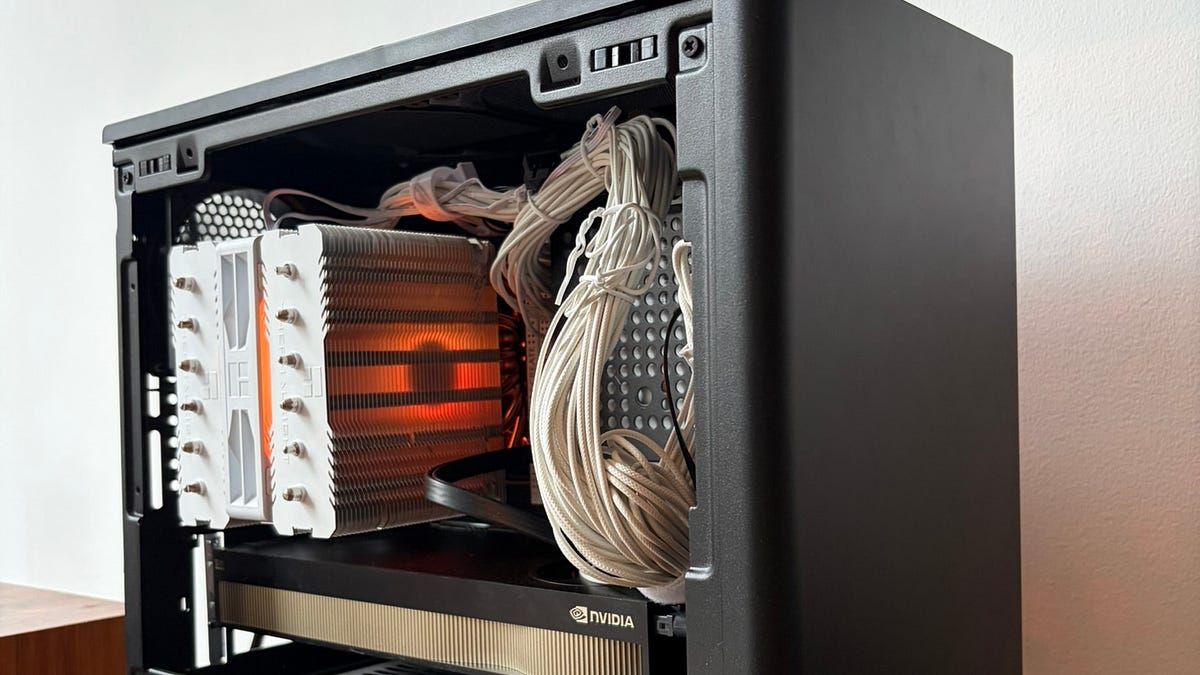
Recognizing these limitations, the hardware budget expanded significantly, moving from a modest $1,000 concept to a $10,000 investment centered around the crown jewel of consumer-grade inference hardware: the NVIDIA RTX 6000 Pro. Released in 2025, the card packs an unprecedented 96GB of VRAM into a single unit, offering a bridge between standard consumer cards and expensive enterprise data center hardware. Crucially, the builder opted for the Max-Q variant, which draws 300 watts instead of the standard 600 watts while sacrificing only about 10 to 15 percent of raw performance. This deliberate choice minimizes heat generation and power draw, allowing the entire system to be housed in a compact mini-ITX form factor rather than a sprawling server rack.
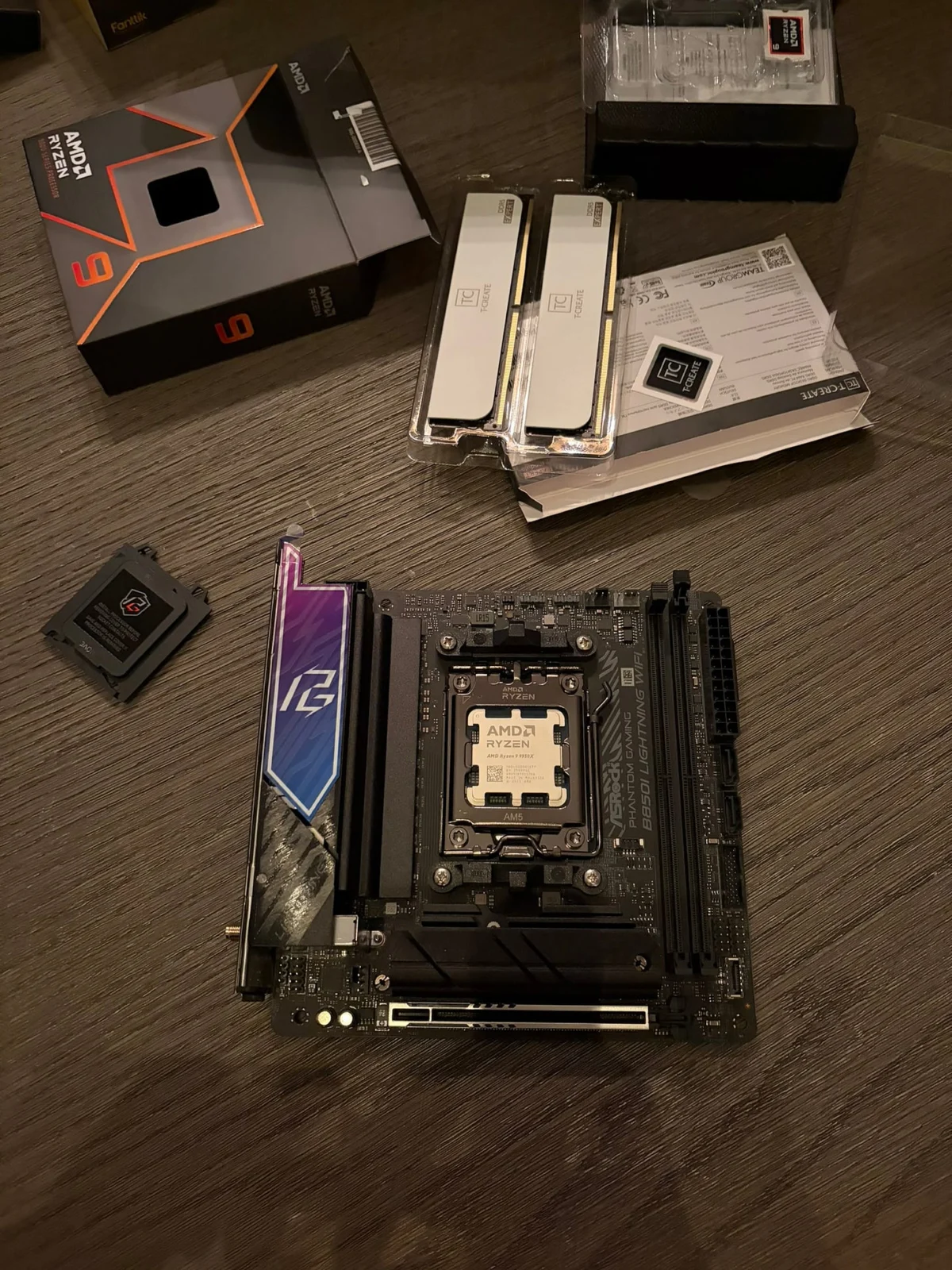
Designing a compact mini-ITX build imposes strict physical constraints. The chosen ASRock AMD B850i motherboard limits internal components to a maximum of two RAM slots, a single primary GPU slot, and two storage slots. The system was equipped with 128GB of high-speed DDR5 UDIMM memory, maxing out the motherboard’s capacity. While enterprise-grade servers utilize ECC memory—which detects and corrects data errors to prevent system crashes—and RDIMM modules to stabilize massive memory arrays exceeding one terabyte, such features require larger ATX motherboards and specialized hardware components that fall outside the scope of a portable mini-ITX inference box.

Rounding out the components are a Ryzen 9950X processor, a Corsair 850W RGB power supply unit, 4TB of NVMe.2 solid-state storage, and a Peerless Assassin 120SE ARGB CPU cooler.
Assembling a machine of this caliber from scratch is an exercise in high-pressure engineering. Handling components worth thousands of dollars with bare hands introduces a distinct psychological weight, where a single misstep during installation can result in catastrophic hardware failure. Over the course of a weekend, utilizing manufacturer manuals, online resources, and technical assistance from AI models, the build gradually came together piece by piece.
The process highlighted the delicate nature of modern PC building, particularly when installing high-end graphics cards into tight enclosures. A minor oversight—such as failing to test system display functionality before fully mounting the bulky GPU—can necessitate a frustrating teardown to isolate connectivity issues. Safely seating a massive, expensive graphics card into a PCIe slot remains a nerve-wracking procedure, balancing the required physical force against the risk of snapping connectors and destroying valuable hardware instantly.

Despite the tension of the assembly process, powering on the machine for the first time and watching its internal illumination spring to life offered a deeply rewarding conclusion to the physical build.
With the hardware successfully assembled, the focus now shifts toward deploying useful software applications and managing local workloads. Although the transition requires a steep learning curve, the initial performance results are remarkably encouraging. Possessing independent, high-end compute power at the individual level unlocks new possibilities for personal and professional experimentation, signaling a broader cultural shift toward digital sovereignty as the next logical evolution in the software landscape.


Comments (0)