


Nearly two months after their highly anticipated debut on Wall Street, United States spot Ethereum exchange-traded funds (ETFs) are finding it increasingly difficult to sustain investor momentum. Following a strong start in late July, the group of nine funds tracking the second-largest cryptocurrency by market capitalization has been met with a combination of structural hurdles, severe regulatory limitations, and a broader macroeconomic market downturn.
While the introduction of these financial products was heralded as a major milestone for institutional cryptocurrency adoption, their performance thus far has highlighted significant hurdles. Persistent capital outflows from legacy products, an unfavorable fee disparity, the glaring omission of staking yields, and a sharp correction in the price of Ether (ETH) have all combined to dampen early enthusiasm.
Industry analysts, market participants, and financial institutions are now closely watching how these funds will navigate a challenging regulatory environment and a cooling digital asset market as they seek to establish a long-term foothold in traditional finance.
Spot Ethereum ETF Performance: A Snapshot
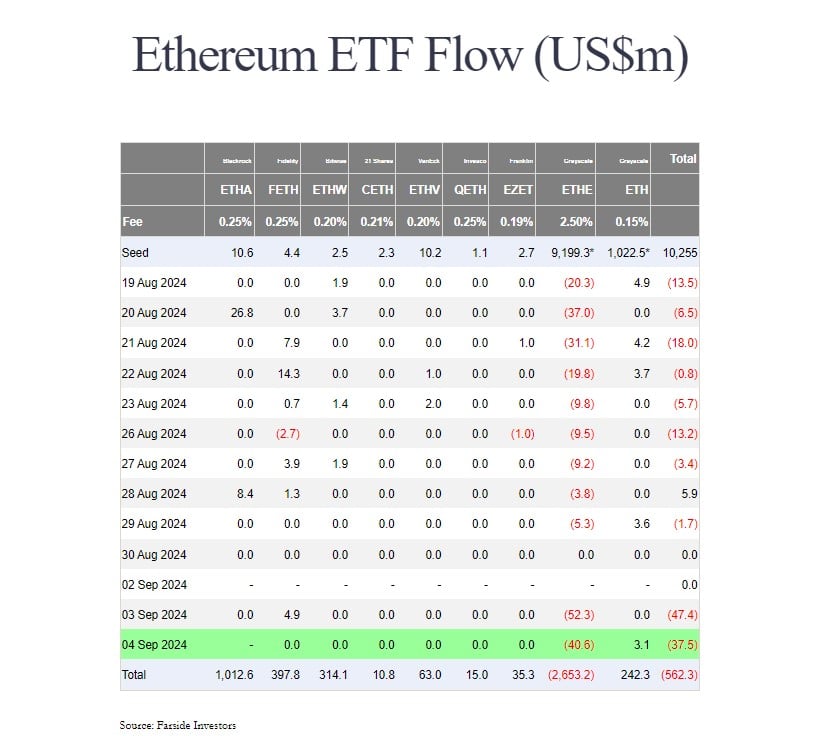
The narrative surrounding spot Ethereum ETFs in the United States is largely defined by a stark divergence between legacy conversion products and newly issued alternative funds. According to data compiled by Farside Investors, the Grayscale Ethereum Trust, trading under the ticker ETHE, has experienced staggering net outflows totaling more than $2.6 billion since it was converted from a closed-end trust into a spot ETF.
A primary driver of these continuous outflows has been Grayscale’s fee structure. The asset manager has maintained a management fee of 2.5% for the ETHE fund, making it approximately ten times more expensive than its newly launched competitors. In contrast, financial heavyweights such as BlackRock and Fidelity levy a much more competitive fee of around 0.25%, while other issuers like VanEck and Franklin Templeton charge even lower rates to attract cost-conscious investors.
Even when Grayscale attempted to mitigate the bleeding by introducing a secondary, lower-cost version of its fund, the offering failed to mount a serious challenge to the dominant market share captured by BlackRock.
BlackRock’s iShares Ethereum Trust, trading under the ticker ETHA, quickly established itself as the frontrunner among the new class of issuers, logging over $1 billion in net inflows since its launch. However, even BlackRock’s flagship product has not been immune to the cooling market conditions. Recently, the fund’s performance has noticeably stagnated, recording four consecutive days of zero net flows as investor appetite dried up across the board.
Other competing products have experienced similarly modest trajectories. Trailing behind BlackRock are Fidelity’s FETH, Bitwise’s ETHW, and Grayscale’s secondary trust offering, which have pulled in net inflows of $397 million, $314 million, and $242 million, respectively. When excluding the massive hemorrhaging from Grayscale’s original ETHE fund, the broader cohort of newly launched spot Ethereum ETFs has managed only minor, incremental gains over the month following their initial trading debut.
These figures stand in sharp contrast to the historic launch of spot Bitcoin ETFs earlier in the year, reinforcing early predictions that Ethereum’s path to widespread institutional integration would face a distinct set of market dynamics.

Staking Could Be a Big Deal That’s Missing
One of the most consequential structural differences between holding physical Ether and investing in a spot Ethereum ETF lies in the absence of staking rewards. Ever since Ethereum completed its landmark transition from a Proof-of-Work consensus mechanism to a Proof-of-Stake model—an event widely known in the crypto community as "The Merge"—staking has become an integral, foundational part of the broader Ethereum ecosystem.
However, because of the Securities and Exchange Commission’s perceived regulatory stance and aggressive posture toward crypto staking initiatives, ETF issuers were heavily discouraged from including staking features in their initial spot Ethereum ETF proposals. Consequently, all nine spot Ethereum products went live on US exchanges completely devoid of any native staking functionality.
Market experts argue that the lack of these built-in rewards significantly diminishes the attractiveness of investing in Ethereum through traditional brokerage accounts. By stripping away the yield generated by locking up the underlying asset to secure the blockchain network, the products lose a vital component of the economic value proposition that attracts institutional capital.
As CoinShares’ head of research, James Butterfill, and other industry analysts have pointed out, institutional investors looking at Ether are acutely aware of the yields available in the native crypto market. Holding an Ethereum ETF without the ability to earn staking rewards has been likened by market participants to buying a bond without receiving a coupon, or owning a corporate stock that refuses to pay out dividends.
Chanchal Samadder, Head of Product at ETC Group, echoed similar sentiments, emphasizing that the lack of staking rewards turns the asset into what many consider to be a "bond with no yield." For traditional portfolio managers accustomed to fixed-income yields or dividend-paying equities, this missing component can prove to be a difficult hurdle to justify to internal investment committees.
Despite these concerns, not all market observers view the absence of staking as a permanent dealbreaker for spot Ethereum ETFs. A prevailing school of thought suggests that the sheer convenience and regulatory compliance of accessing Ethereum through a traditional ETF structure will still attract a broad range of new investors, particularly those who were previously barred from holding digital assets directly due to internal compliance mandates or operational complexities.
Furthermore, prominent voices in the ETF industry, such as Nate Gericis, president of the ETF Store, maintain an optimistic outlook. Gerici believes that the inclusion of staking in US spot Ethereum ETFs is merely a matter of "when, not if," as the domestic regulatory framework gradually evolves to accommodate the technical realities of proof-of-stake blockchains.
Right Product, Challenging Time?
Compounding the regulatory hurdles and structural yield limitations, the launch of US spot Ethereum ETFs coincided with a deeply challenging period for the broader macroeconomic and digital asset markets. Shortly after the funds began trading on domestic exchanges, the wider cryptocurrency market entered a sharp, painful correction.
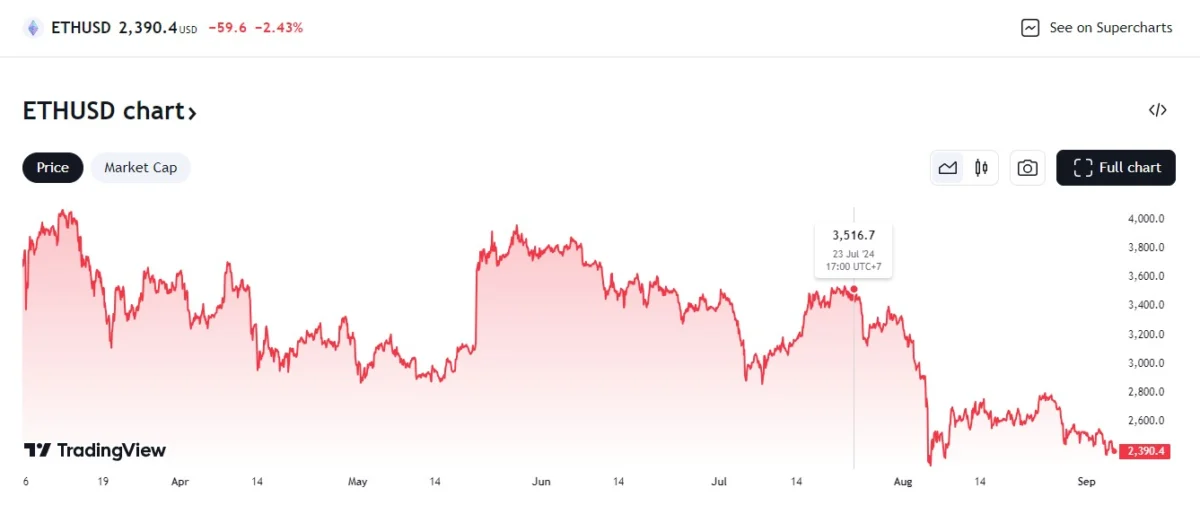
According to data from TradingView, the price of Ether has plunged by approximately 30% since the exact date of the spot Ethereum ETFs’ market debut. While ETH was trading comfortably around the $3,500 mark when the funds first opened for trading, it has since slumped down to approximately $2,400.
This dramatic price contraction has been exacerbated by broader economic factors, including Wall Street stock sell-offs and shifting monetary policy expectations, which have sent shockwaves across risk-on asset classes worldwide. The resulting market pain has naturally impacted both Bitcoin and Ethereum investment products, leading to broad-based risk aversion among institutional and retail traders alike.
The contagion has not spared the pioneer cryptocurrency either. As of early September, US spot Bitcoin ETFs suffered a severe six-day losing streak, during which investors pulled more than $800 million out of the products in a matter of days, according to data compiled by Farside Investors. This synchronized outflow across both major asset classes underscores a temporary retreat of speculative capital as market participants adopt a defensive posture amidst heightened global volatility.
Potential for Future Growth
Despite the gloomy immediate sentiment, market analysts emphasize that the sluggish early performance of spot Ethereum ETFs should not be viewed as an unmitigated failure. In many ways, the current capital outflows and modest inflows were largely anticipated by seasoned financial researchers who understood the inherent differences between Bitcoin and Ethereum as investable assets.
Prior to the launch, Bloomberg intelligence ETF analyst Eric Balchunas correctly estimated that inflows for Ethereum funds would likely be significantly lower than those recorded by Bitcoin ETFs during their historic rollout, citing differing market narratives, user demographics, and utility profiles. Similarly, comprehensive research reports published by digital asset firms Wintermute and Kaiko forecasted that spot Ethereum ETFs would experience more muted initial demand, projecting roughly $4 billion in total inflows over their first full year of trading.
Given that the group of newly issued US spot Ethereum products—excluding the outflows from Grayscale’s ETHE—has already captured over $2 billion in cumulative inflows during a turbulent market environment, the sector is tracking reasonably close to these conservative projections.
While the short-term trajectory has undoubtedly been mixed, market participants maintain that the true test of these financial products will be realized over a longer horizon. As the broader macroeconomic environment stabilizes, the cryptocurrency market recovers from its current correction, and traditional investors grow increasingly familiar with the nuances of digital asset classes, demand patterns are expected to shift.
As long as Ethereum maintains its dominant position as the premier smart contract and decentralized application platform in the blockchain industry, the eventual expansion of Wall Street adoption and the prospect of future regulatory accommodations could still pave the way for sustainable long-term growth in spot Ethereum ETFs.





Comments (0)