



Global financial markets faced renewed selling pressure on Monday, with digital assets experiencing a sharp downward correction even as expectations for a macroeconomic rate cut remained firmly entrenched. While traditional equity indices on Wall Street experienced only modest declines, the cryptocurrency ecosystem absorbed heavy losses across nearly every major sector. At the same time, market participants continued to digest significant corporate updates from prominent industry entities and brace for upcoming high-profile decentralized finance token generation events.

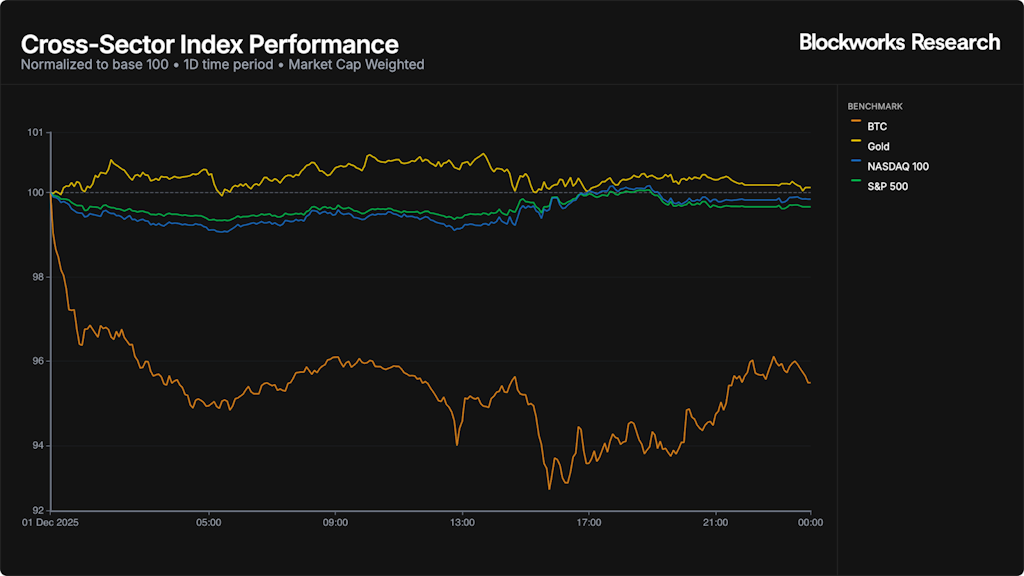
During Monday’s trading session, Bitcoin experienced pronounced downside momentum, dropping by more than 6% at its lowest point before paring some losses to finish the day down approximately 4.5%. Broader risk assets painted a much more resilient picture. The Nasdaq 100 slipped a marginal 0.2%, and the S&P 500 declined by 0.3%. Meanwhile, traditional safe-haven assets like gold outperformed digital currencies once again, posting a 0.1% gain and holding steady near recent highs.
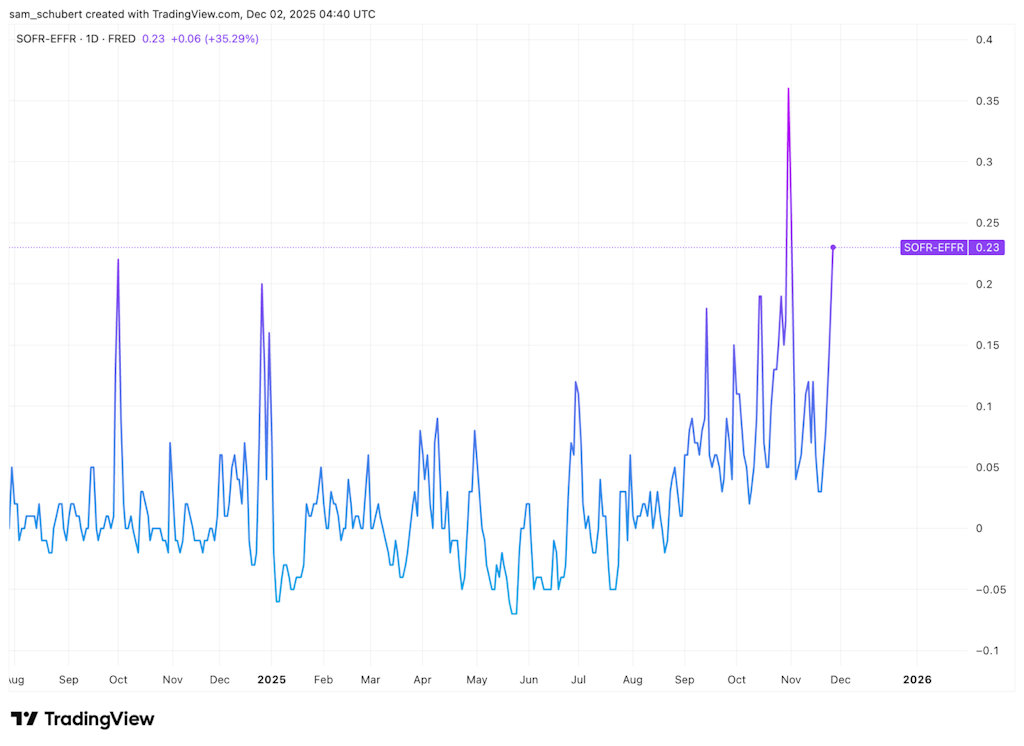
Market sentiment appeared hyperfocused on ongoing developments regarding United States monetary policy and liquidity dynamics. Current projections from the CME FedWatch Tool indicate an 87% probability that the Federal Reserve will implement a 25-basis-point rate cut during its December meeting. However, analysts pointed to significant stress beneath the surface of the financial system, noting that the Secured Overnight Financing Rate (SOFR) has once again climbed materially above the upper bound of the Federal Reserve’s target policy corridor.
When key overnight secured financing rates persistently trade above the top of the policy range, it serves as a clear technical signal that bank reserves are becoming increasingly scarce at the margin and that overall balance sheet capacity across the banking sector is severely constrained. Financial markets are now watching closely to see how the central bank responds, as an adjustment to either its balance sheet operations or its suite of administered rates will likely be required to alleviate this emerging tension and successfully re-anchor money market pricing back inside the targeted policy band.
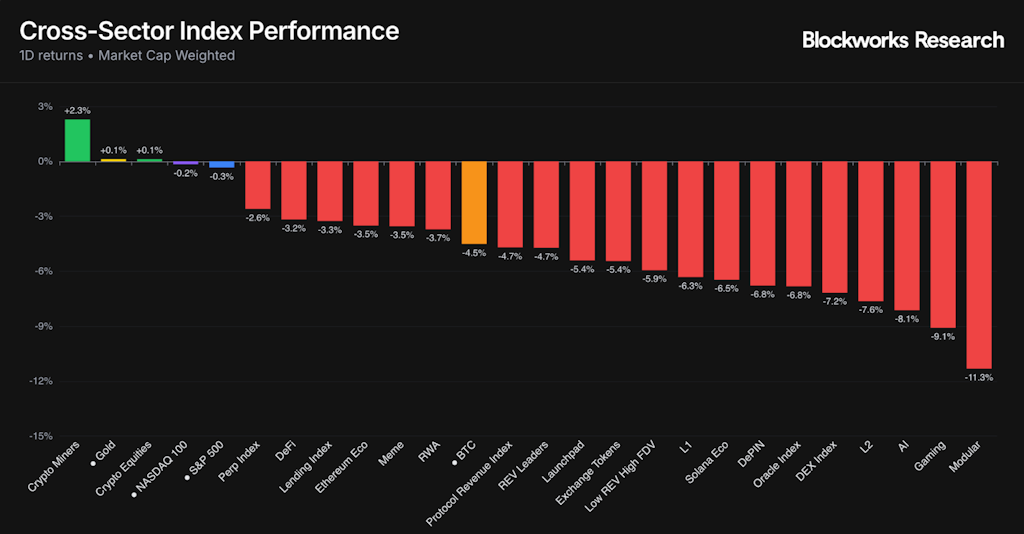
Within the digital asset ecosystem, performance was broadly weak, with almost all sector indices lagging behind Bitcoin following a difficult month for high-beta risk assets. The lone bright spot was found in crypto miners, which managed a 2.3% gain to continue their recent decoupling from the broader crypto complex. Crypto equities also finished slightly in the green, up 0.1%.
On the losing side, sector-specific indices suffered steep double-digit declines. Modular infrastructure tokens led the losses with an 11.3% drop, followed by gaming tokens down 9.1% and artificial intelligence-focused baskets tumbling 8.1%. Layer-2 networks, decentralized exchanges, and decentralized physical infrastructure networks (DePIN) also recorded heavy losses, with indices falling between 6% and 8% on the day. Market observers noted that this pattern is entirely consistent with systematic risk reduction across higher-beta tokens as traders wait for definitive confirmation that monetary authorities will step in to address prevailing liquidity concerns.
Strategy Draws Intense Scrutiny Amid Stock Drawdown and Reserve Disclosure
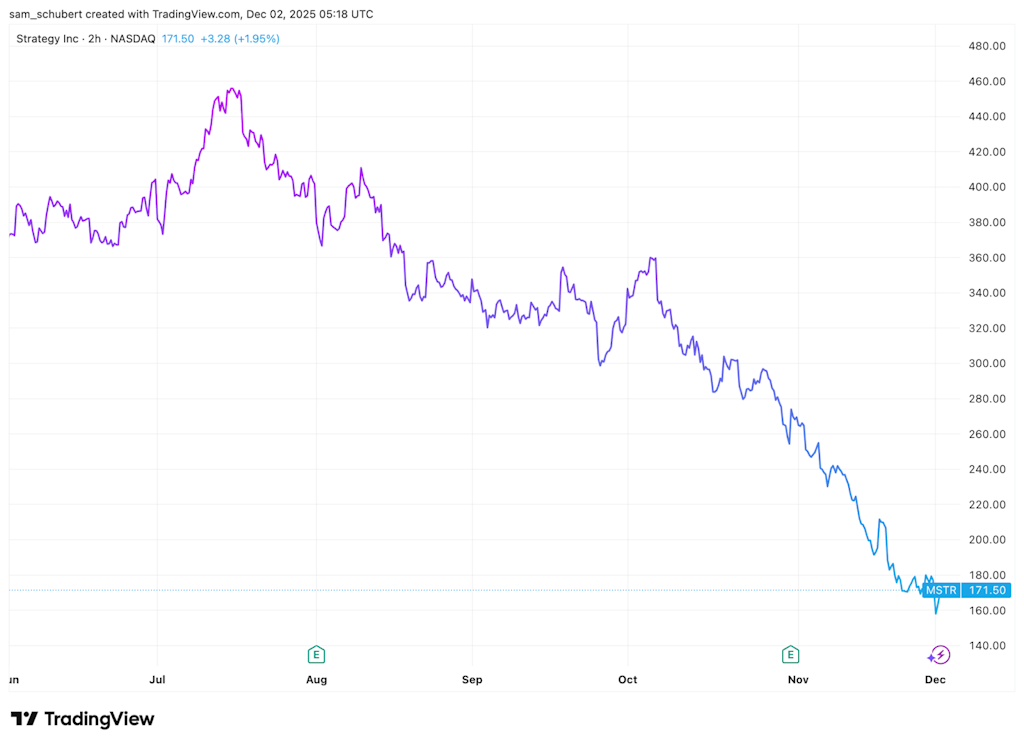
Strategy (MSTR) remained a primary focal point for market participants as the company’s stock price extended its steep recent drawdown. Shares dropped below the $160 threshold during Monday’s session before recovering slightly to close near $171. This latest movement leaves MSTR down roughly 37% over the course of the past month and sitting more than 60% below its highs recorded in July 2025.
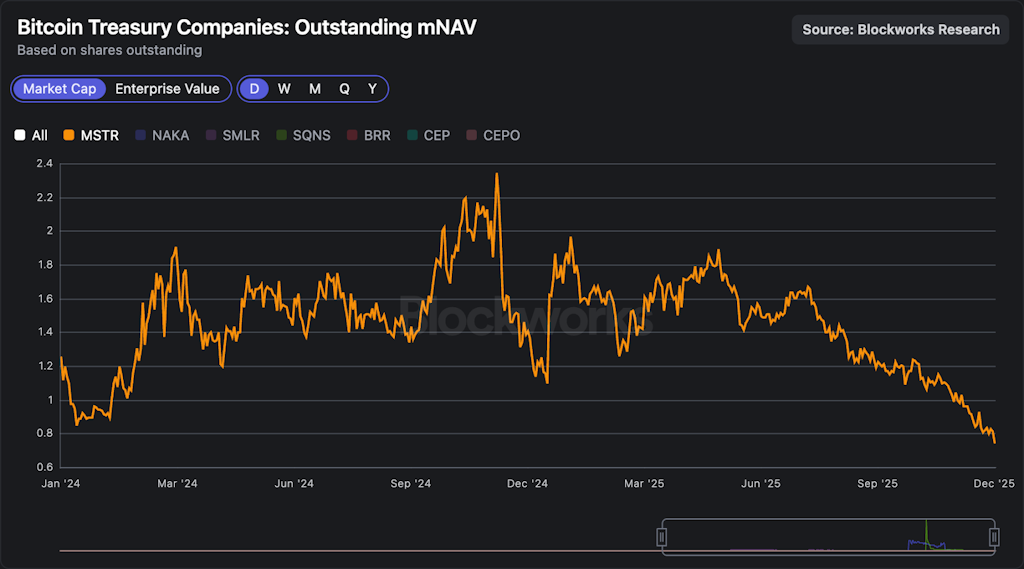
Market analysts highlighted that the company’s outstanding mNAV ratio dipped below 1 in early November and has continued to slide toward 0.75, reflecting the broader risk-off sentiment gripping the market. This dynamic has sparked growing concern regarding potential cascading effects, as publicly traded vehicles holding massive digital asset treasuries can inadvertently amplify drawdowns and trigger forced selling pressures if their underlying equity trades at a persistent discount to the value of their treasury assets.
When an investment vehicle trades persistently below its net asset value, issuing new equity ceases to be an accretive mechanism and instead becomes actively value-destructive. This effectively neutralizes one of the company’s primary funding levers, forcing management to consider alternative measures—such as selling portions of its bitcoin treasury or executing derivative strategies—precisely at a time when both the underlying cryptocurrency and the company’s equity are already enduring severe downward pressure.
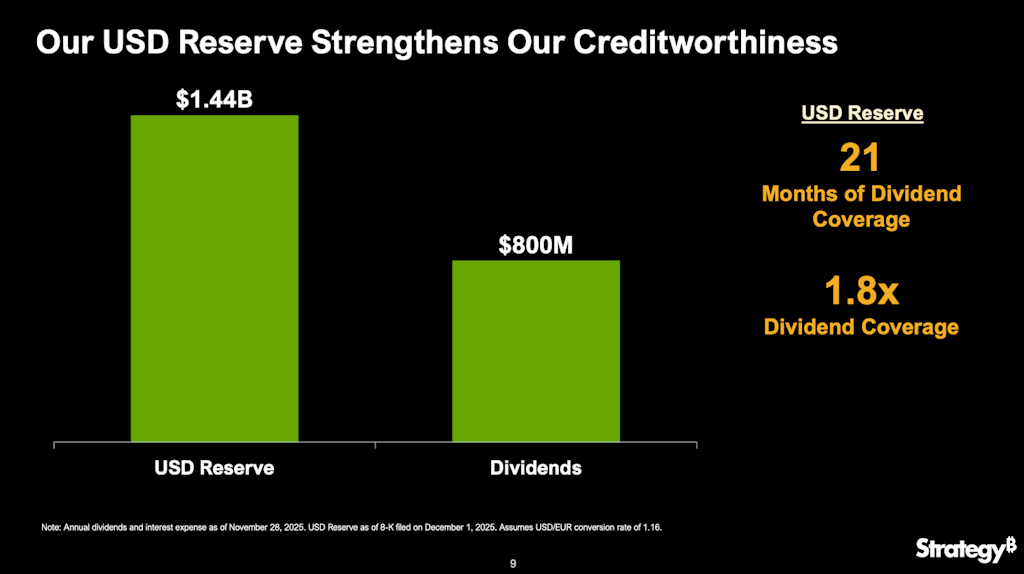
To counter these anxieties, corporate disclosures released on Monday revealed that Strategy has successfully accumulated an approximate $1.4 billion cash reserve, funded through recent equity issuance initiatives. Management stated that these funds are explicitly earmarked to cover at least 12 months of dividend payments, with an ultimate strategic objective of extending that coverage window to 24 months. This financial buffer is designed to ensure that the firm can continue meeting its dividend obligations without being forced to liquidate any portion of its approximately 650,000 bitcoin holdings, even if the current market drawdown persists for an extended period. This disclosure provided a measure of relief to investors, helping the equity recover some of its intraday losses.
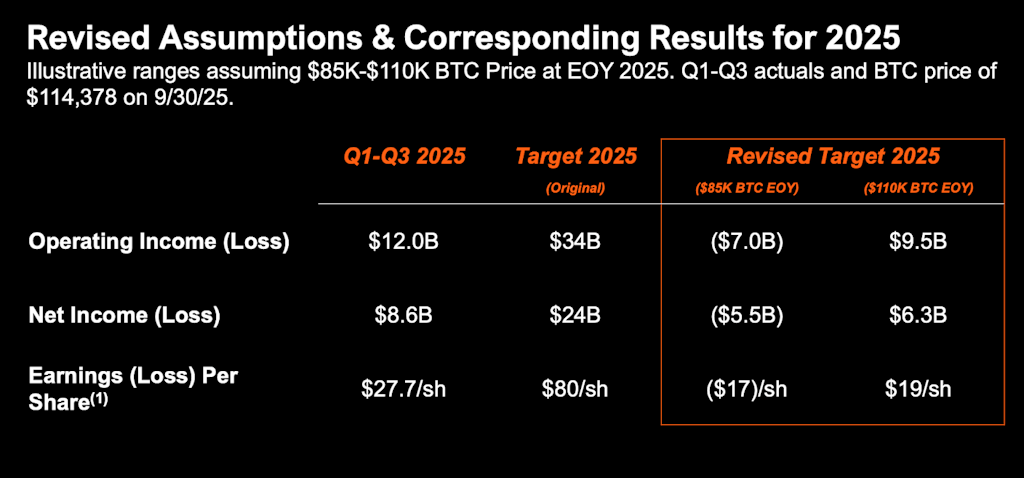
Concurrently, corporate leadership adjusted its internal assumptions for the cryptocurrency market, lowering its year-end bitcoin price expectation from $150,000 down to a range of $85,000 to $110,000. This downward revision reduced the company’s projected full-year dollar gains from bitcoin to between $8.4 billion and $12.8 billion, making full-year GAAP earnings highly sensitive to where the cryptocurrency ultimately trades at year-end. During an investor conference call, executives noted that a year-end bitcoin price falling below roughly $94,000 would result in the company operating at a net loss, whereas a price remaining above that threshold would support positive net income.
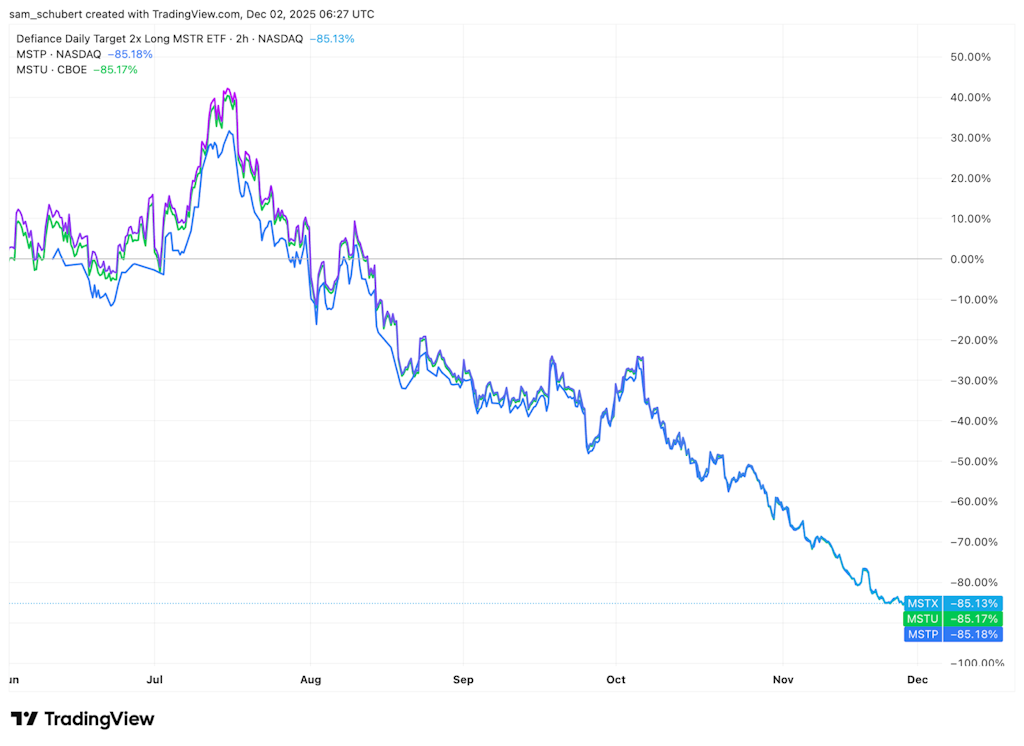
The severe volatility has hit leveraged exchange-traded products tied to the Strategy trade particularly hard. Products such as MSTX and MSTU, which are designed to deliver double the daily return of Strategy stock, rank among the ten worst-performing US-listed exchange-traded funds of the year, having suffered losses exceeding 80%. A newer fund, MSTP, has experienced a similarly steep decline since its inception. Combined, the total assets under management across this trio of leveraged products have shrunk from more than $2.3 billion in early October to approximately $800 million. These products have demonstrated how significant drawdowns in an underlying equity combined with a 30% pullback in bitcoin can be heavily magnified by volatility decay, where compounding mathematical losses erode capital even if the underlying asset eventually stabilizes. This dynamic has left retail investors who entered late with substantial losses, turning what was once a wildly popular leveraged trade into a textbook example of negative reflexivity.
HumidiFi Sets WET Token Sale Amid Transparency Concerns
Attention in the decentralized finance sector turned toward Solana as HumidiFi prepared for the launch of its WET token sale. WET is scheduled to become the inaugural initial coin offering hosted on Jupiter’s Decentralized Token Formation platform, with public trading across Meteora and HumidiFi slated to commence immediately following its token generation event. HumidiFi operates as a proprietary automated market maker developed by Temporal, a Solana-native research and development firm that also oversees Nozomi, a transaction landing service, and Harmonic, a block-building system designed to compete with Jito.
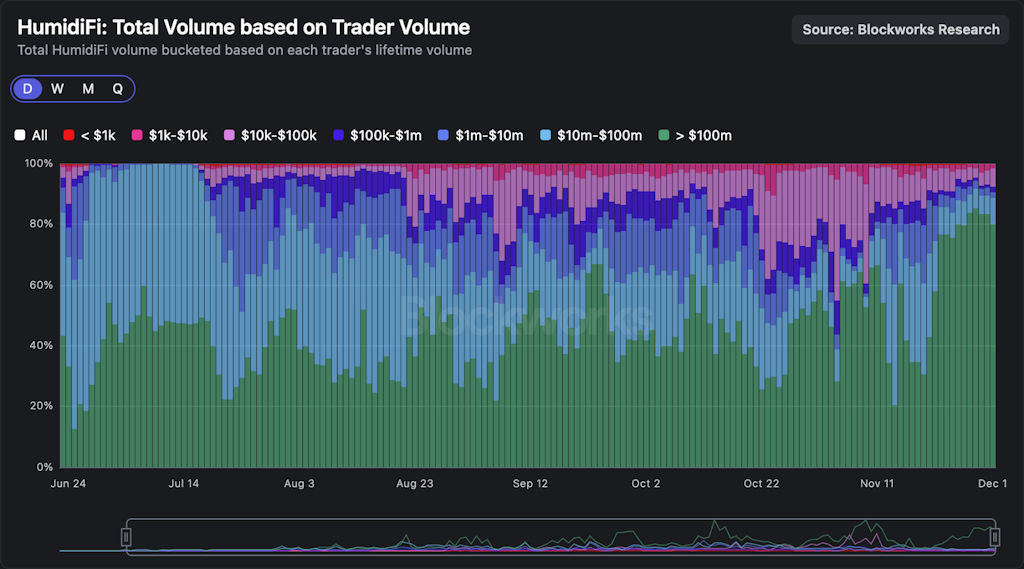
Ahead of the launch, the project team published details regarding the tokenomics of the asset. WET will feature a maximum supply of 1 billion tokens, with 10% specifically carved out for initial coin offering participants. Eligibility for the pre-sale allocation has been divided into distinct categories, including top platform traders identified via a user snapshot taken on historical trading activity. Historical data indicates that traders achieving lifetime volumes exceeding $100 million have accounted for more than half of HumidiFi’s daily volume, suggesting that these heavily active wallets, likely consisting of professional market makers and arbitrage bots, will capture a significant share of the pre-sale allocation.
The remaining token distribution is split across several major categories, with the Zero Position Foundation slated to receive 40%, an ecosystem development pool allocated 25%, and core labs receiving 25%. Although the announcements did not explicitly link the operation of the Zero Position Foundation to a specific legal entity, industry observers presume it will be managed by Temporal. Similarly, the labs allocation is expected to benefit Temporal given its foundational engineering contributions to the automated market maker. The ecosystem allocation is anticipated to incentivize various project partners, engineering teams, and liquidity providers.
WET is set to launch with an initial circulating float of 23%, bearing structural similarities to previous low-float, high-fully-diluted-valuation token launches that have historically faced severe downward pressure across the Solana decentralized finance ecosystem. Market participants expressed surprise that the project team opted for a low-float architecture given how unfavorably the broader market has treated similar token models over recent years. According to the release schedule, a substantial portion of the total supply will be unlocked in scheduled increments over a two-year period following the generation event.
From a fundamental perspective, HumidiFi has rapidly established itself as a dominant proprietary automated market maker by trading volume over recent months. During November, the platform captured 51% of all Solana-native stablecoin trading volume and accounted for 36% of total decentralized exchange volume across the entire network, surpassing established automated market makers such as Orca, Raydium, and Meteora. Furthermore, HumidiFi’s trading metrics have begun to rival major centralized exchanges, averaging over $1 billion in daily spot volume for the primary digital asset pair and occasionally exceeding the volume handled by prominent centralized venues.
Despite its impressive technical performance and rapid capture of market share since launching, the impending token launch has raised questions among market observers regarding token utility and corporate governance. Users will be able to stake WET to earn fee rebates, though the development team explicitly emphasized that the asset should not be viewed as an investment. With the token sale imminent, several fundamental questions regarding the exact governance structure of the foundation, potential ownership rights, and the rationale behind a profitable proprietary trading desk utilizing a public token raise remain unanswered by the project’s disclosures.





Comments (0)