



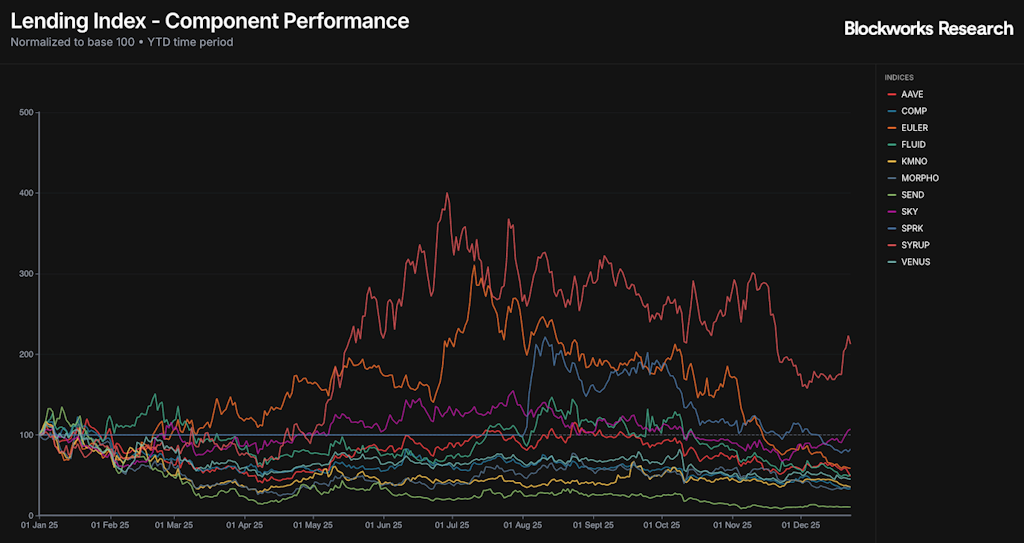
Maple (SYRUP) has emerged as a standout performer in the decentralized finance ecosystem, surging 26% over the past week to outpace all other money markets tracked in specialized lending indexes. Amid a shifting macroeconomic and crypto market backdrop, Maple stands shoulder-to-shoulder with Sky
as the only assets in its index to post positive year-to-date performance. However, Maple’s momentum dwarfs the competition, boasting a remarkable 112% gain compared to Sky’s 7%. This impressive price action and sustained market resilience prompt a closer examination of what is driving Maple’s current strength and how the protocol successfully navigated a tumultuous sector evolution to capture institutional capital.
As one of the longest-standing lending protocols in decentralized finance, Maple’s journey has been defined by adaptation and structural reform. Following the severe credit crises and market contagion of 2022, the protocol executed a critical strategic pivot. Moving away from the riskier undercollateralized lending models that plagued early crypto credit markets, Maple transitioned toward a fully secured, overcollateralized operational framework tailored for institutional participants.

Under this revamped institutional approach, Maple introduced permissionless Syrup pools—specifically accepting USDC and USDT deposits to mint yield-bearing tokens such as syrupUSDC and syrupUSDT—alongside permissioned pools restricted exclusively to USDC. Capital deposited into these pools is strategically deployed over-the-counter to institutional borrowers, with every loan strictly backed by overcollateralization using bitcoin or other highly liquid, high-quality digital assets. This conservative yet scalable architecture restored confidence among sophisticated market participants and laid the groundwork for massive capital inflows.
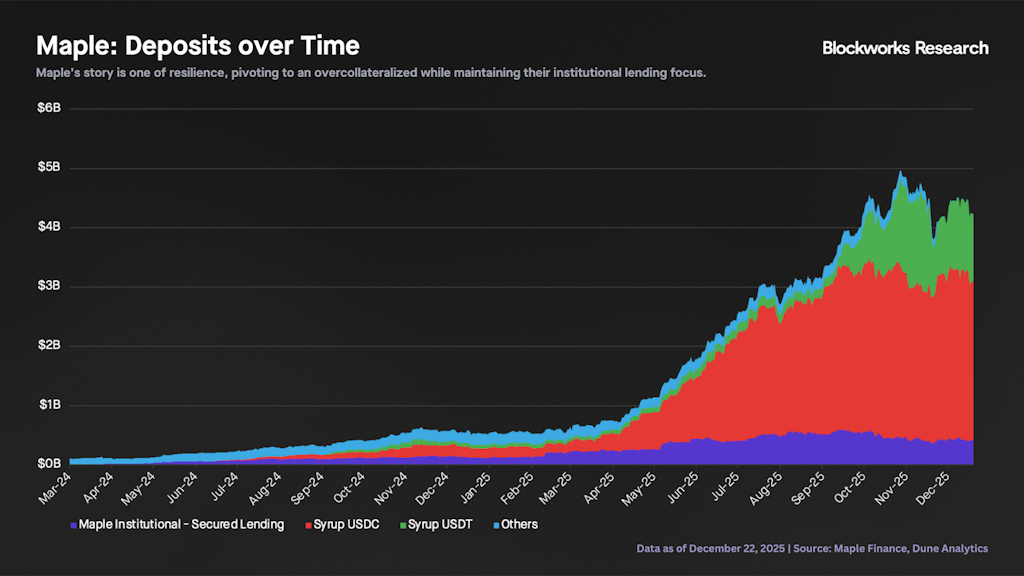
These strategic shifts have translated into extraordinary balance sheet expansion, with Maple recently surpassing the significant milestone of $4 billion in total deposits. A breakdown of this liquidity reveals that approximately 63% of total deposits reside within the syrupUSDC pool, while the syrupUSDT pool accounts for 27%. The remaining 10% of capital is held within Maple Institutional, the protocol’s dedicated permissioned secured lending pool.
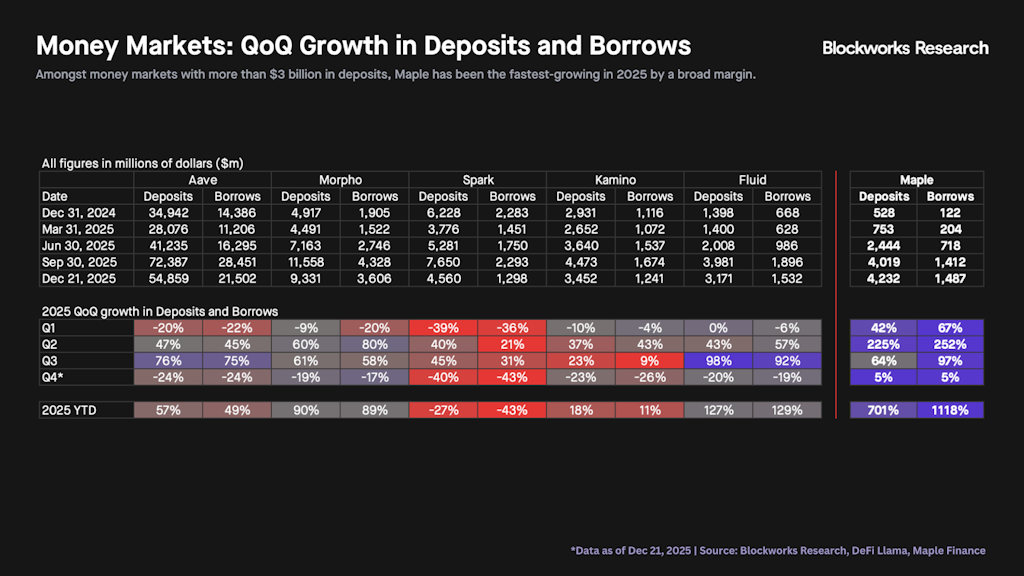
When measured against broader decentralized finance money markets, Maple’s growth trajectory stands out for its consistency and velocity. Among competing protocols holding more than $3 billion in deposits, Maple has registered as the fastest-growing platform in nearly every single quarter of the year. The exception was the third quarter, during which it ranked a close second behind Fluid. The platform’s watershed moment arrived in the second quarter, characterized by an explosive 225% surge in deposits alongside a more than 250% increase in outstanding borrows.
On a year-to-date basis, Maple’s metrics are staggering. Total deposits have expanded by an exceptional 701%, while outstanding loans have skyrocketed by 1,118%. Crucially, the pace of loan origination has consistently outpaced the influx of new deposits, pointing to high capital utilization and robust, sustained demand from institutional borrowers seeking liquidity against their digital asset holdings.
The engine powering much of this expansion has been the syrupUSDC pool, which anchors over $2.66 billion in deposits as of late December. A primary selling point for syrupUSDC has been its ability to generate sustained, attractive yields tied directly to the healthy, stable demand from Maple’s vetted institutional client base. Throughout the year, syrupUSDC has consistently outperformed benchmark yields within its peer cohort, maintaining an average annual percentage yield of approximately 8%.
Nevertheless, the competitive landscape of decentralized finance is relentlessly dynamic. In recent months, these yields have faced compression. Competing protocols, most notably Morpho, have maintained highly competitive USDC yields since August and even managed to outperform syrupUSDC sharply during the month of November.
To evaluate these competitive dynamics accurately, analytical methodologies rely on market-weighted USDC supply rates across rival protocols, isolating the base interest paid directly by borrowers while excluding temporary token incentives or promotional rewards. Computing trailing 30-day annualized rates provides a clear baseline to measure how syrupUSDC stacks up against broader market benchmarks.
Beyond its core lending mechanics, a major catalyst accelerating the adoption of syrupUSDC and syrupUSDT has been deep, expansive integrations across the broader decentralized finance ecosystem. Maple’s yield-bearing stablecoins have successfully integrated into Pendle’s principal token markets and have been systematically onboarded as accepted collateral types across a diverse array of prominent money markets, including Aave, Fluid, Jupiter Lend, Spark, and Kamino.
These integrations unlock powerful financial strategies, enabling users to execute looping mechanisms and optimize capital efficiency against non-yield-bearing stablecoins. This widespread distribution network positions Maple to capture accelerated growth phases, particularly during periods when syrupUSDC successfully outcompetes broader benchmark yields, including alternative stables like Ethena’s sUSDe.
The translation of these surging adoption metrics into protocol revenue offers a compelling look at Maple’s underlying financial health. When evaluating quarterly revenue figures and price-to-sales multiples against competing money markets, Maple trades at an exceptionally attractive valuation on both a growth-adjusted and fully diluted valuation basis. The protocol’s annualized revenue run rate has experienced a massive 533% year-over-year expansion, climbing from $1 million in the final quarter of the previous year to a forecasted $6.6 million for the fourth quarter.
Tokenomics and distribution structures have also played a supportive role in fostering market confidence. All initial allocations designated for the core team, early advisors, seed investors, and public sale participants reached full vesting status, entirely eliminating the risk of near-term supply overhangs that often weigh down token valuations. Furthermore, the SYRUP token achieved a strong score on the Token Transparency Framework, reflecting a high degree of transparency regarding the project’s fully disclosed revenue streams, clear rights governing value accrual to token holders, recognized advisory service providers, and verifiable executive team personnel.
Driven by robust fundamental growth, high capital utilization, attractive institutional yield generation, and a clean token structure characterized by limited supply overhang and comprehensive public disclosures, Maple continues to command strong relative strength. As the leading performer among lending tokens year-to-date, the protocol enters the next market cycle with a solidified institutional foundation and deep integrations across the decentralized financial architecture.





Comments (0)