



Financial markets have experienced a severe correction across artificial intelligence, momentum, and semiconductor equities, with prominent names recently pulling back 30 to 40 percent from their all-time highs. While many market participants and external observers are quick to declare this correction as the ultimate top for the semiconductor and memory sectors—claiming victory for sitting on the sidelines—such celebrations may be premature.
The core debate surrounding the entire AI investment thesis ultimately boils down to a single, fundamental question: Is the global demand for compute finite or infinite?
In typical market discussions, critics often trap themselves in local minims of experience, observing enterprise adoption rates that appear slower than anticipated and extrapolating those localized delays onto the broader macroeconomic landscape. While enterprise adoption of AI tools may indeed take time to mature, this friction actually creates a powerful counter-incentive for agile, AI-native firms. These smaller competitors are positioned to outcompete legacy enterprises with significantly leaner workforces, proving that when deployed effectively, artificial intelligence can be vastly more economical than scaling traditional human labor.

However, viewing capital expenditure on AI strictly through the lens of enterprise software misses the broader structural shift. At its core, the global AI buildout is about bringing massive amounts of raw compute online. That compute is destined to be utilized by an expanding array of buyers, including sovereign governments, hyperscale cloud providers, frontier labs, and autonomous robotic systems. Each of these distinct consumer categories possesses a vastly different price tolerance and budget threshold for acquiring compute.
While certain market participants may eventually tap out as compute costs rise, assuming that no other buyer exists with a higher budget ignores economic reality. For sovereign entities and hyper-scalers, securing compute is a non-negotiable imperative driven by high-stakes geopolitical and corporate competition. For others, compute serves as a direct, highly cost-effective replacement for human labor overhead. Believing that the market will "overbuild" or surpass true capacity assumes that these diverse consumer groups will eventually reach an end-state of total satisfaction—a premise that treats intelligence as a static commodity rather than an expanding economic engine.
Decoding Hyperscaler Capital Expenditure and Cloud Economics
The sheer scale of capital expenditure by hyper-scalers remains a primary source of anxiety for public market investors, many of whom worry these technology giants are risking their corporate futures on excessive infrastructure spending. Critics frequently question whether public cloud providers are miscalculating their investments, but this perspective overlooks the immense pricing power these companies wield.

Public cloud offerings are remarkably expensive, and hyperscalers have spent decades mastering how to extract maximum value from enterprise clients, convincing generations of businesses that they are incapable of scaling infrastructure independently. In return, cloud providers routinely mark up standard non-CPU compute costs by multiples of 10 to 20, while layering on additional fees for data storage, logs, and egress bandwidth.
This ecosystem relies on high switching costs. Bandwidth within major cloud environments is kept relatively inexpensive, but egress fees and data transfer costs ramp up dramatically when customers attempt to migrate workloads elsewhere. For the hyperscalers, running out of compute is an existential threat. If a cloud provider lacks sufficient GPUs to service major tenants, those clients are forced to slowly migrate to competing platforms. Consequently, hyperscalers are compelled to invest aggressively in infrastructure, maintaining pricing power because their tenants are deeply entrenched in multi-year architectural lock-ins.
Financial comparisons between enterprise cloud pricing and private hardware deployment highlight the staggering margins embedded in the cloud model. High-end AI inference hardware that can be assembled independently for a fraction of the cost commands recurring monthly on-demand rental fees on major cloud platforms that allow providers to recoup their initial server hardware investments in less than two years. Even when factoring in the ongoing costs of real estate, power infrastructure, financing, and facilities management, hyperscalers retain massive structural premiums.
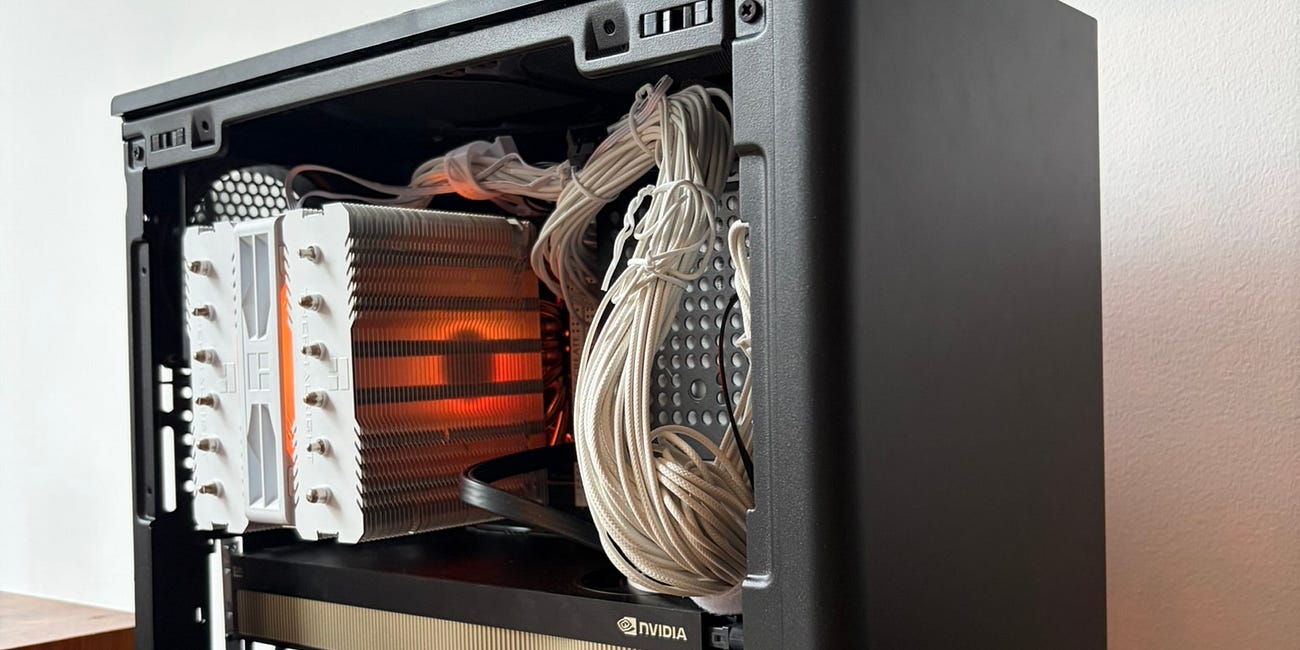
Furthermore, industry hardware dynamics are shifting in unexpected ways. Rather than depreciating rapidly, older-generation graphics processing units have demonstrated surprising durability in both residual value and rental costs. While newer semiconductor architectures offer greater compute efficiency, those efficiency gains are frequently counterbalanced by surging global demand for high-bandwidth memory. Hardware can be conceptualized as a dual-component asset class where raw compute may gradually become commoditized, but that deflation is continually offset by the rising economic value of integrated memory. Consequently, the return on investment for hyperscaler capital expenditures is running significantly higher than consensus market expectations.
Evaluating the Backlog and the Reality of Recursive Demand
Skeptics frequently attempt to evaluate the current infrastructure buildout by drawing historical analogies to past technological waves, such as the nineteenth-century railway expansion or the dot-com internet boom. However, these comparisons overlook a defining characteristic unique to artificial intelligence: recursive demand.
During historical infrastructure buildouts like the railroads or early internet deployment, economic diffusion relied entirely on human adoption. Society needed a critical mass of human users to consume bandwidth or transport goods to justify the underlying capital investment. Artificial intelligence operates under entirely different economic parameters. In the AI paradigm, compute possesses the capability to spawn its own secondary compute demand. The upper limit of compute consumption for an individual or organization engaged in autonomous software engineering or automated problem-solving is virtually limitless. When an enterprise or developer discovers a positive return on investment use case, continued reinvestment in compute transforms into a self-funding economic engine.

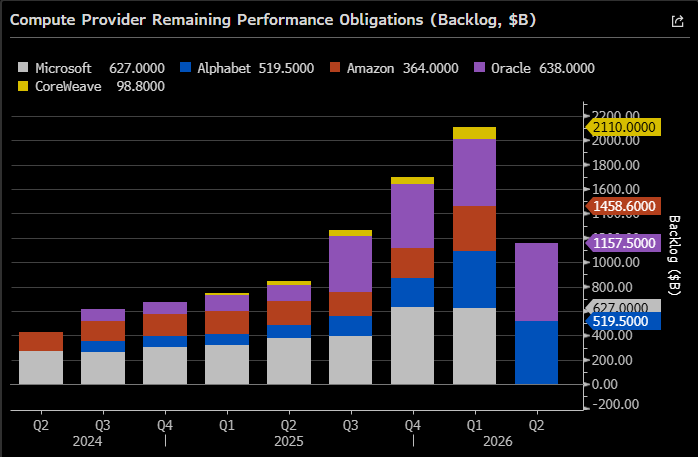
Market indicators underscore this structural demand acceleration. Industry backlogs for compute infrastructure have expanded exponentially over recent years, growing from hundreds of billions of dollars to well over two trillion. Dismissing this multi-trillion-dollar wave of spending as a speculative bubble ignores the underlying reality of customer queue lengths and real-time utilization rates. While frontier AI labs account for a substantial portion of global compute demand, enterprise clients and specialized applications make up an increasingly vital share of the broader market.
The division between training and inference workloads further clarifies the sustainability of these investments. While training cutting-edge state-of-the-art models requires staggering upfront capital outlays, those models function as high-value intellectual assets capable of generating substantial lifetime value through inference services. Although open-source models continue to diffuse through the market and offer alternative avenues for developers, frontier models retain unique capabilities required to solve complex, high-value problems that command steep pricing premiums. Furthermore, servicing massive state-of-the-art models requires immense physical memory footprints and specialized hardware clusters that remain entirely out of reach for consumer-grade or edge infrastructure.
Inference workloads continue to demonstrate robust profitability, with operating margins frequently ranging between 50 and 70 percent depending on the serving provider. Even as some enterprises transition away from centralized hosted providers to manage their own localized hardware, that transition simply shifts the point of hardware acquisition rather than destroying the underlying demand. Because inference has established itself as the dominant and continuously expanding workload, overall demand consistently outstrips available semiconductor supply.

Navigating the AI Trade and the Future of Global Compute
The contemporary artificial intelligence trade remains one of the most polarizing segments in global financial markets. It is simultaneously viewed by optimists as the foundational infrastructure of a new industrial revolution and by skeptics as an overextended capital expenditure bubble bound for a catastrophic collapse.
Many institutional investors struggle to reconcile the rapid pace of technological evolution with corporate balance sheet impacts. Simplistic market reactions to isolated model releases often trigger irrational sell-offs across semiconductor and memory equities, overlooking the reality that advanced models frequently demand significantly higher memory bandwidth and hardware resources to execute successfully. Although equity valuations have experienced sharp run-ups, many sector leaders continue to trade at modest forward multiples driven by market skepticism regarding the sustainability of demand beyond the near term.
Traditional economic theory posits that when demand surges dramatically, market supply eventually catches up to restore equilibrium. However, because artificial intelligence converts homogenous physical inputs—such as electrical power, real estate, and advanced silicon—into an infinitely scalable intangible output known as intelligence, society’s appetite for compute may prove structurally insatiable.
This dynamic is further amplified when factoring in the anticipated proliferation of autonomous robotics over the coming decade. Amid slowing demographic growth and declining birth rates in developed nations, traditional economic models reliant on expanding human labor force participation are increasingly constrained. Without artificial intelligence and advanced robotics to drive productivity and economic expansion, global GDP growth faces severe deceleration.
Consequently, the physical expansion of data centers is pushing into new geographic regions as traditional power and land grids in North America approach capacity constraints. The global economy is steadily evolving toward a state where compute infrastructure will be deployed wherever power and space remain viable, ensuring that the structural demand for semiconductors and memory remains robust. As markets continue to grapple with the pacing of supply timelines versus real-time demand, the fundamental question remains: whether one views the current market correction as a buying opportunity or a structural warning ultimately depends on whether they believe the human desire for intelligence and compute has a ceiling.




Comments (0)