


Conventional measures of economic growth omit some of the largest gains in living standards and therefore underestimate economic progress. — William Nordhaus

In 1906, Upton Sinclair went undercover in Chicago’s grueling meatpacking plants to expose the brutal realities of industrial
poverty, immortalizing his findings in The Jungle. His harrowing depictions detailed families living in overcrowded squalor, children working in hazardous, dehumanizing factories, and laborers maimed by the machinery of early industrial capitalism with no safety net to catch them. More than a century later, the digital age has birthed a new kind of data-driven investigator. Enter Michael W. Green, an asset manager whose recent viral thesis claims that American households earning less than $140,000 are living in poverty.
The assertion quickly captivated social media, leaving observers to marvel at how modern families allegedly manage to survive on such meager six-digit incomes. Under Green’s logic, roughly two-thirds of the American population would theoretically qualify for federal food stamps. Yet, unlike Sinclair, Green does not appear to have spent any time speaking with the families he purports to champion. Had he done so, he might have recognized that his spreadsheets were steering him wildly astray.
Economists and data analysts have been swift and nearly unanimous in their dismissal of Green’s viral thesis. Scott Winship bluntly characterized the study as "the worst poverty analysis I have ever seen." Similarly, Tyler Cowen concluded that Green’s framework is fundamentally flawed, noting that the underlying concepts are incorrect, the details are misguided, and the use of evidence is deeply flawed. Jeremy Horpedahl echoed these sentiments, calling it ridiculous to use a $140,000 threshold as a legitimate measure of poverty, while Noah Smith argued that Green completely misinterprets his own numbers and reaches overly simplistic conclusions.
While Green has attempted to defend aspects of his analysis, a credentialed economics degree is hardly required to spot the flaw: it stretches credulity to argue that a household bringing in $139,000 annually is facing genuine deprivation or going hungry.
To be fair, Green’s argumentation carries a layer of nuance. He frequently cites the Massachusetts Institute of Technology’s "cost of thriving" index, which estimates that while it took a median male worker roughly 30 weeks of earnings to support a family in 1985, the same standard now requires 63 weeks. Yet critics argue this perspective overlooks profound changes in the quality, accessibility, and sheer variety of goods available in the modern economy.
Reflecting on the comparison, observers who lived through the 1980s note that while pop culture, fashion, and the absence of constant digital connectivity may have held a certain charm back then, day-to-day material life is demonstrably easier and better today. From automobiles and household appliances to power tools, video games, and consumer goods, nearly everything purchased to improve the quality of life has advanced dramatically. In most cases, these goods are also cheaper when adjusted for quality improvements.
Even the contentious issue of housing reveals a more complex reality under closer examination. As Cowen points out, housing costs have undoubtedly risen, but Americans today enjoy significantly more living space on average than ever before, alongside lower average household densities. Healthcare paints an even starker picture. Rather than acting as a purely inflationary drag, the broader trend in modern medicine has been deflationary in terms of utility—meaning the cost of purchasing an extra expected year of life has declined over time. Most consumers would undoubtedly prefer contemporary healthcare at current prices over the medical limitations of previous decades.
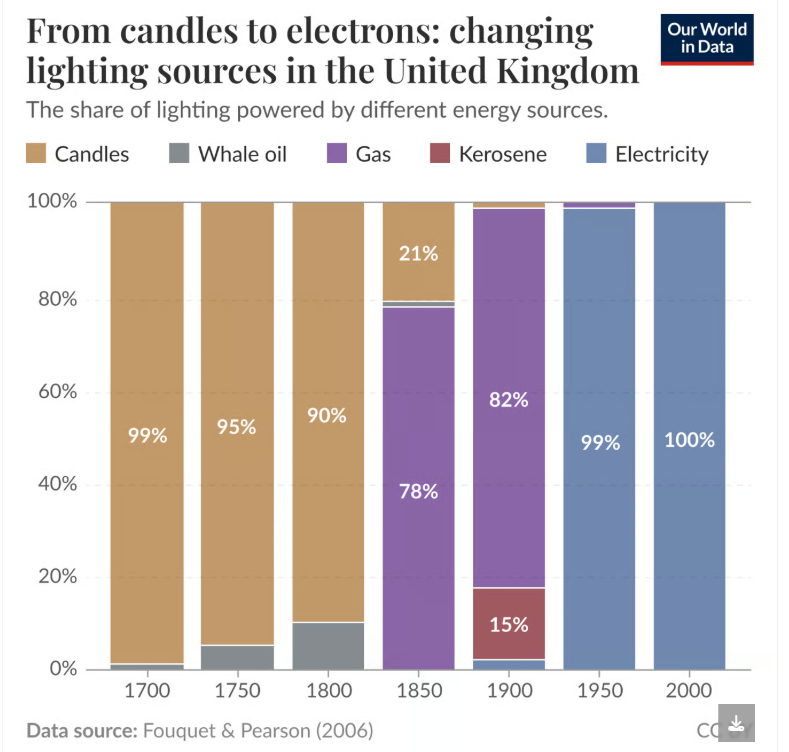
This core intuition—that standard economic metrics often fail to capture massive improvements in what a dollar actually buys—builds upon foundational economic theory. Nobel laureate William Nordhaus famously demonstrated this phenomenon by examining the cost of lighting through the lens of lumens. By tracking lumen-hour costs across candles, kerosene lamps, and electric bulbs, Nordhaus illustrated how traditional historical assessments of economic growth drastically underestimated progress because they ignored quality changes.
In 1800, lighting a room for three hours required roughly three hours of labor. Today, the same illumination demands only a fraction of a second of work—representing a roughly 43,000-fold improvement in efficiency that official inflation and GDP statistics largely missed. Because technological advancements and quality enhancements are never fully reflected in headline GDP figures, society consistently underappreciates how drastically living standards have risen.
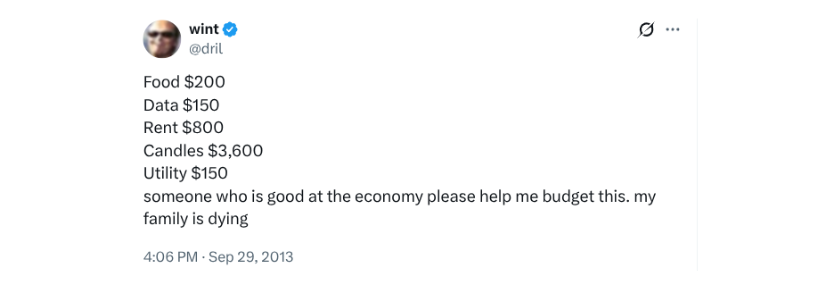
Conversely, ignoring these quality adjustments leads to absurd conclusions about the modern cost of living. Much like a satirical internet premise about an individual forced to purchase 1800s lighting technology at historical costs—leaving nothing behind for modern necessities like healthcare or smartphones—Green appears to make a parallel statistical error. He examines modern spending on vastly superior goods and services without accounting for the exponential value consumers receive in return.
Furthermore, high prices are frequently a byproduct of robust demand, which can only exist when a vastly larger share of the population can afford to participate in the market. A $140,000 annual income purchases an immense basket of goods and services in the contemporary United States.
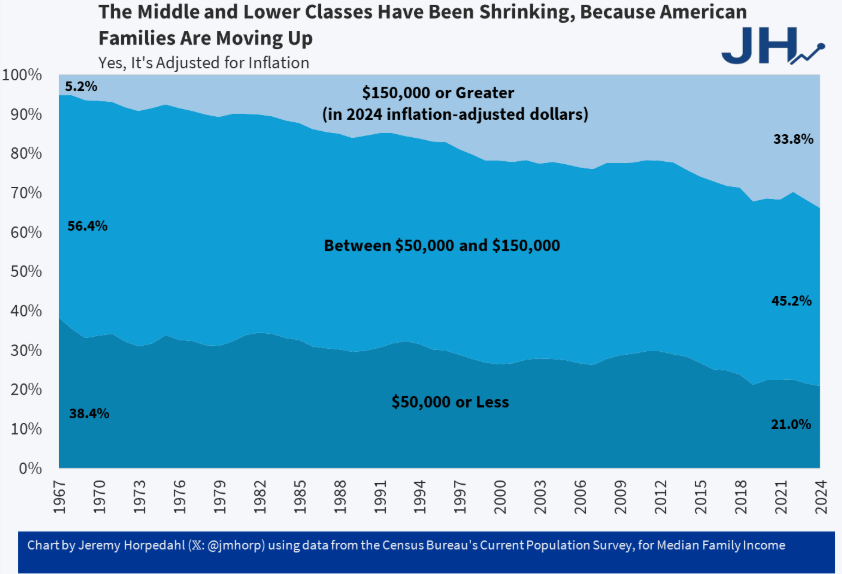
Broader macroeconomic data underscores a very different trajectory for the American populace. While narratives often center on a shrinking middle class, that contraction is largely the result of upward mobility into the upper class. In 1967, just 5.2% of American families earned more than $150,000 in inflation-adjusted terms; today, nearly 34% of households cross that threshold.
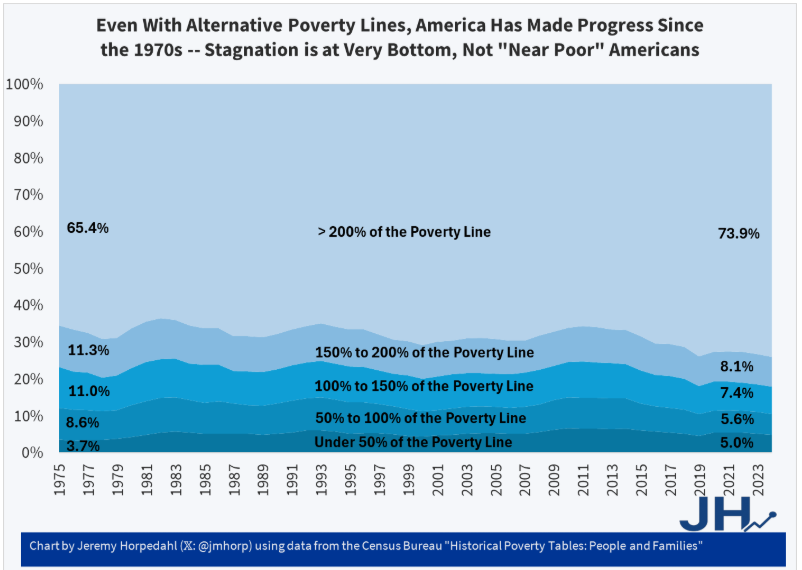
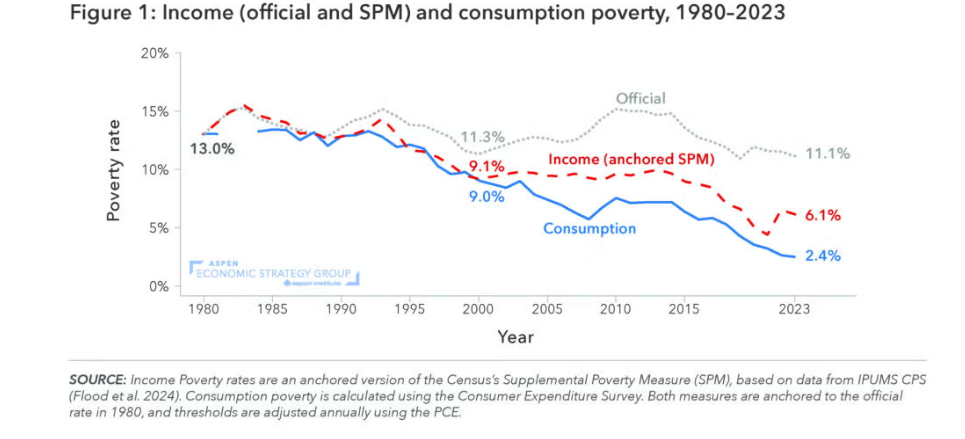
At the same time, movement into the middle class has expanded. The percentage of Americans living on incomes exceeding 200% of the federal poverty line—roughly $60,000 for a family of four—has risen by more than eight percentage points since 1975. Regardless of how poverty is measured, long-term trends point downward. Comprehensive data from the Economic Strategy Group indicates that poverty has fallen by roughly half using traditional income-based metrics, and by more than 80% when evaluated through consumption-based measures.
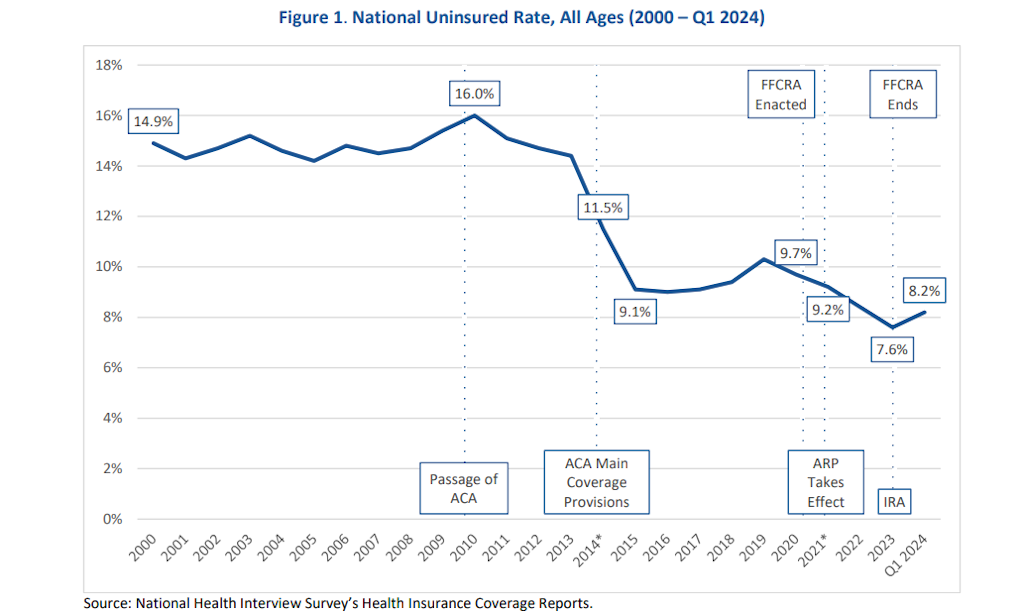
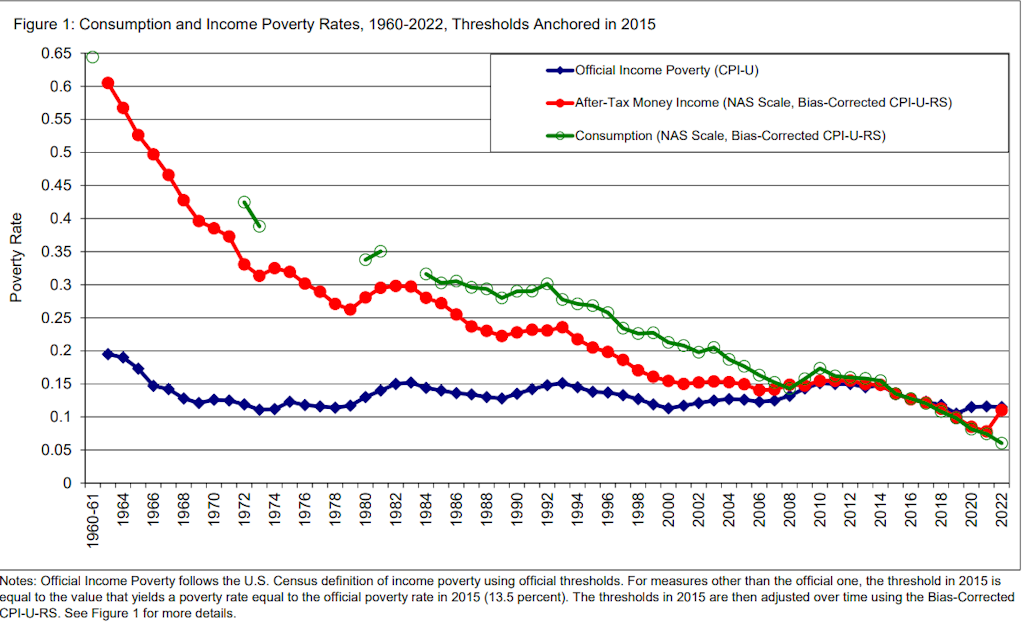
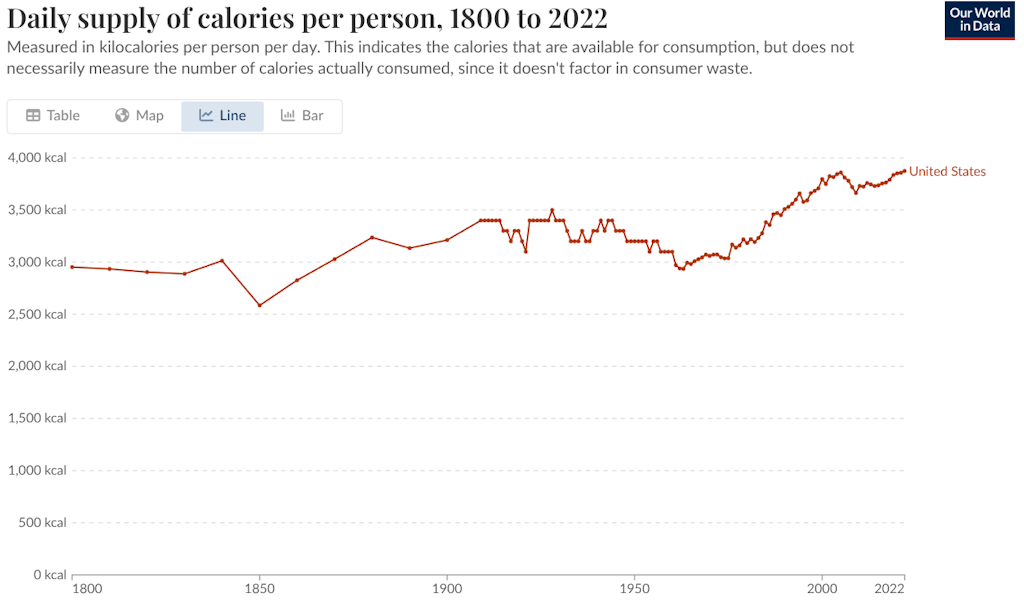
Academic studies focusing on "consumption poverty" and after-tax resources reveal that official Consumer Price Index-based poverty metrics consistently fail to capture decades of material improvement. Americans consume an average of roughly 3,800 calories per day, representing a 15% increase since 1985. Meanwhile, the uninsured rate for healthcare dropped to 8.2% in 2024, down significantly from 16% in 2010.
Historically, basic necessities like lighting were so expensive that individuals routinely risked their lives on the open seas hunting whales for oil. Today, a million lumen-hours of light—the equivalent of running an ordinary household lightbulb continuously for two months—costs a fraction of what it did centuries ago, when the same illumination required the equivalent of a small fortune. When evaluated through Nordhaus’s time-price framework, the cost of an hour of light has plummeted from three hours of labor in 1830 to a mere fraction of a second today.
Ultimately, while data-driven commentary will continue to spark viral debates about the modern economic squeeze, a comprehensive look at consumption, technological progress, and historical benchmarks suggests that living standards remain on a remarkably upward trajectory.





Comments (0)